Worldly Partners
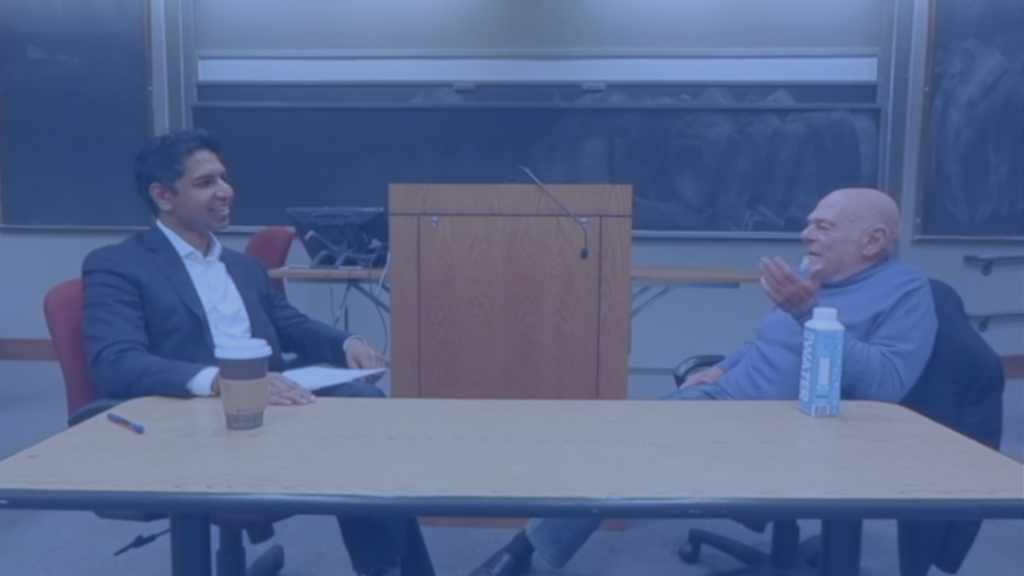
Arvind with Ken Langone
In addition to leading Worldly, Arvind is a professor who has received a university all-star teaching award and brings deep real-world insight into the classroom. Each year, the course features conversations and lectures with distinguished guests who share candid perspectives from senior levels of business leadership, offering students exposure to industry thinking and practical insights within an academic setting. Guest participation is strictly for educational purposes only.
The videos and individuals shown are for illustrative and informational purposes only. The appearance of any person does not constitute an endorsement, testimonial, or recommendation of Worldly Partners, nor does discussion of specific companies constitute investment advice. No individual shown is being compensated for their appearance, and their statements (if any) are not representative of the experience of any clients or investors. Nothing presented should be construed as individualized investment advice.
Ken Langone
Ken Langone: On “Doing the Right Thing” in Business, Investing, and Life
In this Distinguished Speaker interview, Home Depot co-founder Ken Langone shares the straight-shooting wisdom that has guided his track record as a billionaire investor. From his belief that a company’s success hinges on its people, culture, and willingness to “do the right thing” to his discipline as a concentrated, long-duration owner, Ken argues that judgment, values, and character are just as fundamental to investing and business building as financial analysis.
Full transcript
Introduction
Arvind Navaratnam (00:00:11):
Ken, it’s an honor to have you with us today. Thank you very much for being here. I’ll keep my remarks brief and Ken needs no introduction as the co-founder of Home Depot, and given his storied career across Invemed, remaking New York’s hospital system, I grew up in New York in the ’90s and he really turned that around.
Ken Langone (00:00:30):
We didn’t do a whole lot. We didn’t do a whole system. We did work up one.
Arvind Navaratnam (00:00:33):
You did one, but it set an example. Sometimes you just need one.
Ken Langone (00:00:37):
I hope we did that. I hope we did that.
Arvind Navaratnam (00:00:37):
Pressprich, your relationship with Ross Perot, et cetera. We’re recording Ken’s fun straight-shooting wisdom for posterity. My students have been preparing all semester along for this discussion and they have read everything Ken has written, including his great book, I Love Capitalism, listened comprehensively to his podcast interviews and researched everything they could find about him and his multi-decade holds in the public domain. I’ll be asking the questions the students themselves prepared on their behalf for a smooth fireside discussion and then opening up to Q&A afterwards. So let’s jump right in.
Ken Langone (00:01:17):
Right to it.
Family and early influences
Arvind Navaratnam (00:01:19):
Awesome. So, Ken, maybe we can start towards the beginning and you could talk a little bit about your parents and grandparents and how they shaped how you see the world, your style of leadership and how you think about risk-reward.
Ken Langone (00:01:31):
Well, I was born luckily into a wonderful loving family. And the one gift my parents gave to my brother and me was unconditional love. I wasn’t a notable student. In fact, I barely got out of high school and I got into Bucknell, believe it or not, without applying. I serendipitously was able to meet the dean of Admissions. On a Saturday morning, I was up in Bucknell to see friends of mine from the next town. I was raised in Roslyn. They were raised in Port Washington. They were going to Bucknell. I went to see them. It turned out to be a house party weekend and I thought, “Hell, this is what you do in college. College is for me.”
It was 1953 and I was going to join the Marines. My mom wouldn’t sign me in because my brother was already in Air Force, an airborne paratrooper, and Korean War was on. And mom said no, I had to wait in September. Well, this was May of the previous of the same year, ’53. And I met this guy, “Come in my office, I want to talk to you. So what are your plans?” I said, “I’m waiting, I’m 18 in September because I’m going to go in the Marine Corps.” “Why do you want to go in the Marine Corps?” “My brother’s in the Army and I’d like to be doing what he’s doing.” He was five years older than me.
Long story short, out of the blue, he sends me a letter the next week telling me he’d like me to come to Bucknell. And at the bottom of the letter in hand, the letter was typed, but in hand is, “In college, you’ll have to work much harder than you did in high school.” Well, I didn’t do a damn thing in high school except have jobs to make some money. Well, my parents gave me unconditional love. Money was tight. My parents lived classically from paycheck to paycheck. They both worked. My dad was a union plumber who suffered manic depression, by the way, but kept going to work, thank God.
And mom worked in a school cafeteria. And I didn’t know what we didn’t have. I always felt like, “Hey, there’s plenty of food in the table. The house is warm in the winter.” In the summertime, it’s not so pleasant because it’s hot and there’s no air conditioning. But I didn’t know anything about air conditioning, so I didn’t feel like I missed anything. And I had a series of jobs as a kid and those jobs sharpened my skills. And by the way, if there’s something I bring to the party, this is it, that I could spend a little bit of time with somebody and pretty much gauge whether they were honest or dishonest, whether they were sincere or insincere, whether they were true or whether they were phonies.
And that’s been largely the foundation of my investment style. [inaudible], “What about earnings? What about sales projections? What about …” Yeah, all that stuff’s important. But if you go back and look at the great business successes, they evolved around the personalities of the people involved with them. Classic example was Sears, I’m sorry, Kmart, which was grown out of S.S. Kresge, a five-and-dime store chain, was effectively the originator of the discount store. And they were opening new stores in what they call Kmart. And at that time there was a guy in Bentonville, Arkansas who had four Ben Franklin five-and-dime franchise stores by the name of Sam Walton.
This past Saturday, I just read in the paper, Kmart has closed its last store out in Bridgehampton. No more Kmarts around. And Walmart is the biggest company in the world today, phenomenally successful. And if you go back and study it, you’ll say it’s all about the people. They’ve had the good fortune of having a series of leaders, one from the other to the other, to the point where you got Doug McMillon now, who I think is as great a leader in the business as anybody I know.
Arvind Navaratnam (00:06:08):
That’s great.
Ken Langone (00:06:11):
And so anyway, that’s how I do it.
Home Depot culture and listening to associates
Arvind Navaratnam (00:06:15):
And culture. They’ve had an incredible culture, which we’ll come to.
Ken Langone (00:06:18):
Oh, it’s great. This past week, Home Depot announced that all of its associates, not just the people that work at the store, but the people that were … We don’t call our company yet. We don’t have a headquarters. We have what we call a store support center. We never wanted a headquarters, but we wanted the message to be what we do is all about what we do in the stores. We succeed and we fail. And so we have what we call an inverted triangle. The base of the triangle is on top and the point of the triangle is on the bottom. The base of the triangle is the hourly associate in the store. The point is CEO and the chairman.
Why? Because what that kid does on the floor of that store over the long term is going to have more of an impact on how well we do than anything Bernie or Arthur or I or anybody else could do. Well, this past week, they just announced that all their associates, other than the kids that work in the stores, everybody in the company has to work eight hours every 90 days in a store.
Arvind Navaratnam (00:07:32):
That’s great.
Ken Langone (00:07:33):
Well, let me go back. When we founded the company, I had my own investment banking firm. I had a lot going on, but I always had enough time to go to the openings of Home Depot stores. It blew my mind how well we were doing it, how much the world accepted what we had. And one board meeting, it was the November board meeting of 1983, I was at the board meeting, I was talking about this in the store and that in the store and that in the store. Bernie said to me, “Where the hell did you get all that information?” I said, “I got it in the store.” “What do you mean you got it in the store?” “Yeah, I go in and I talk to the kids and they tell me. I’m getting their firsthand experiences of, ‘We need this,’ or, ‘We shouldn’t do that,’ or whatever.”
So Bernie said, “Gee, that’s interesting.” I go, Bernie, “You want to know something we want to do? Every board member should be obligated to visit three stores every 90 days.” Now, until I left, a board member had to visit three stores every 90 days. They had to let the secretary or the chairman know which stores they visited in that quarter. If they want, they can write a little summary of what they saw. The important thing was when we got together as a board, we carved out a piece of time just to talk about our experiences in the stores because that’s where it is.
Arvind Navaratnam (00:09:12):
That’s great. 100%.
Ken Langone (00:09:12):
That’s where Sam won the war. That’s where Walmart killed Kmart. Merchandising, pricing-
Arvind Navaratnam (00:09:23):
Correct.
Ken Langone (00:09:23):
… service levels, in stock, all those things that only happened right if you have the people in the store doing the right thing.
Arvind Navaratnam (00:09:32):
Absolutely. So there’s a lot there. Maybe you turn to the topic of Home Depot, which is one of my favorite subjects. Can you share insights into the challenges and opportunities you faced in the first 20 years of Home Depot’s life?
Ken Langone (00:09:53):
The biggest challenge we had was how do we keep this culture. We always encouraged from day one, Bernie would go to the stores and say to the kids, “Don’t listen to those,” blanks. “Do what you think is right. Do the right thing.” Bernie almost encouraged attitude. I did too. And believe it or not, the kids … And by the way, who’s a kid? Today, a kid is under 89 years old.
Arvind Navaratnam (00:10:29):
Yeah, I love that. Yeah.
Ken Langone (00:10:30):
Okay?
Arvind Navaratnam (00:10:31):
Yeah.
Ken Langone (00:10:32):
Bernie and I always encourage the kids to speak their mind as long as the intent was to make the company better, to make every effort to accommodate a customer, to use their brains, which they all have, out of stocks, merchandise, location, all those things that help the customer have a worthwhile, helpful experience. I’ll give you a for instance. Our stores used to open on Thursdays for openings. We used to open grand opening on Thursdays because we had circulars in the local newspapers. So that coincided with the circulars and it would drive people to the stores and the store would be open.
However, we have what we call the soft opening on Wednesdays where we just open the door, and if you wanted to stumble in and go around, okay. Tuesday night before the soft opening, I love to go in the store. I still love to go in the Home Depot store. We’re walking all around and a kid in the plumbing aisle grabs me. And one thing about these kids, they’re not couth. They tell it like it is. The kid said to me, “You in the company?” I said, “Yeah.” He said, “Can I ask you a question?” I said, “Sure.” He said, “Were you guys born stupid or did you become stupid?” I said … Another guy probably would’ve fired the kid. I said to the kid, “Probably a combination of both. Now tell me why.”
So he said to me, “Come on, I will show you something.” So he takes me over to a big cardboard box, as big as where toilet tissue comes in. They’re big boxes. And he points there and he says, “See those items there? Those are plungers.” He said, “Somebody goes into that box to get a plunger, they got to reach all the way down to the floor level, that box on the floor. Then you got the shelving above it for other products.” He said, “They go in there and it’s dirty,” but he said, “Worse, they can’t see it, so it’s not in their mind.” Now think about it. You don’t wake up on a Saturday morning and say to your wife, “Hey, honey, let’s go to Home Depot and buy a plunger.”
You typically know you need a plunger when you haven’t got one. So 3:00 in the morning, the toilet’s stuffed up and you haven’t got a plunger now. Plungers have nice, what are they, a piece of wood with a rubber suction thing on the bottom. You know what they look like. They got nice [inaudible]. So I said to the kid, “Okay, we’re stupid. Now, why are you smart? Show me.” He said, “Why don’t you put pipe hooks on the edge of the rail of the shelving and put the plungers in like if you go to a gun store, how they display guns on a wall?” I said, “Well, let me ask a question. Why don’t you try it?” He said, “What do you mean?” I said, “Well, if you think it’s such a great idea, why don’t you give it a shot?” “Can I?” I said, “I don’t know. Try it. Somebody raises hell, just tell him you think it’s going to work.”
The first Saturday was open four days later. I’m walking in the store and the kid grabbed, “Hey, come here, come here. I want to show you. I want to show you something.” I go over there and he points to where the pipe hooks are and there’s nothing in the pipe hooks. I said, “Would you put it back in the box?” He said, “Hell no, they’re all sold.”
Arvind Navaratnam (00:14:27):
Yeah, such a great story.
Ken Langone (00:14:31):
[inaudible], but you don’t know where you’re going to get your next best idea.
Arvind Navaratnam (00:14:34):
Yes, right.
Ken Langone (00:14:36):
And you want to motivate people and that’s where management psychology … Unfortunately, in too many companies, NIH not invented here is a paralysis. It’s constipating. It’s bad. We have 500,000 kids working on … Who’s a kid? And they said, “You’re under 89.” We got 500,000 kids in this store right now. They got a bunch of good ideas. Some of them are crazy and won’t work, but that’s okay.
So that was a genius. That is a genius of the company. And by the way, we went through a period of time, when Arthur left, he bought the football team in 2000. And we had Nardelli come in from GE. And to Bob’s credit, for the first four years he was there, everything he touched, he made better. It was all low-hanging fruit. And we were in trouble. We were growing. We were opening up, believe it or not, we were opening up 200 stores a year.
Arvind Navaratnam (00:15:44):
Wow.
Ken Langone (00:15:44):
We were opening up a store every day and a half. The volume in the new stores overcame the inefficiencies of the old stores. So collectively, “Hey, this is great. Sales are going up, earnings are going up,” but underneath, the older stores were getting neglected. They were allowed to fester, so to speak. The last two years Bob was there, it was hell on Earth because he was cutting muscle. He was cutting muscle. Frank Blake replaced him, and I say this all the time, fairness dictates that Frank be considered one of the founders of the company, even though he didn’t get involved with us until we were … That was 2000.
Arvind Navaratnam (00:16:35):
Yeah, sure.
Ken Langone (00:16:42):
20 years after we were founded. Frank embraced and restored the culture to a healthier state than it ever was before. The results show for itself. We’ve had a succession of people that have embraced and nurtured the culture. After Frank, Craig Menear. After Craig Menear, Ted Decker now and he’s doing a splendid job in this new program, I said where everybody in the company has to work eight hours every 90 days in the store. Very important.
Arvind Navaratnam (00:17:15):
And so what did you … No, keep going, Ken. Sorry.
Ken Langone (00:17:18):
No, no, I’m saying I’m good.
Recognizing leadership talent
Arvind Navaratnam (00:17:20):
Yeah. So what did you see … I’m going back to that time in your book and what did you see in Frank that others might’ve overlooked and what general lessons … You’ve been so successful in picking the right people over time. What general lessons can you share about that?
Ken Langone (00:17:38):
I’ll tell you what I saw in Frank, which is in short, short supply in the world. I saw a terribly able man, incredibly able, with more humility than I’ve ever seen in one human being. Understand his background, he graduated from Harvard, got a law degree from Columbia Law School. He did so well at Columbia Law School that he was picked to be one of the nine clerks of the Supreme Court for the year he graduated. He then went to General Electric where I first got some knowledge of him, working on … He was a lawyer for the power division. He and Nardelli got to know each other when Bob came. The year after Bob came, Frank came.
After that, he became the number two guy at the Department of Energy, I believe. And Nardelli then hired him from there to come in to be the head of Strategy at Home Depot. And I got to tell you, Frank has exceeded my wildest dreams. I had no doubt. There was considerable pushback when we decided that Bob and we should go separate ways. I was then lead director. My pick was that Frank should succeed him. And there was confirmation because Frank had … If you look at Frank’s CV, “Hey, wait a minute, what the hell’s he doing about retail?” And I said, “I knew this guy, I got to know him, and I thought he was fair, honest and possessed of an abundant, abundant quantity of humility.” Still is.
Frank … So the board wanted to make him acting CEO. I said, “No way. If we’re going to make him act as CEO, let’s cut his legs off. He has a better chance of succeeding. We’re going to make him CEO, and if he blows, we’re going to fire him, just like we did with Nardelli. We know how to do that. We just did it.” Board went along. Frank had wings the first day he showed up for the job and he’s been fabulous. As I said, the kids grew to love him in the store. When he walks into a store, to this day, he’s like a rock star and that’s the glue that holds this place together.
Arvind Navaratnam (00:20:16):
Yeah, I love how he reached out to the founders of Home Depot and then would just walk lots of stores and speak to people in stores to really bring back that culture. It was such a stark contrast to the administration.
Ken Langone (00:20:32):
I’ll give you an example of Frank. He and I were going to walk some stores together in Columbus, Ohio. He flew up to New York. He picked me up and flew me out to Columbus. By the way, I say this to Frank with affection, not with ridicule. He dresses like he’s dressed in a room or closet with no lights. I don’t know what the hell he’s going to have on, but that doesn’t matter. He shows up and he’s got a little piece of paper. We go to the first store in Columbus and he wants to know where the augers are. Augers are these little devices you put in down a toilet when you got a stuffed up toilet and it agitates and whatever the blockage is, it opens it up.
He goes over and checks the price of augers because somebody told him that our price of augers was outrageous. Frank wanted to see firsthand, and sure enough, the price was on the market. There was no outlandishness about it, but that’s Frank. Frank had a great … Besides having a global vision, he had a great attention to detail as well. And most importantly, Frank understood the real glue to this company are the kids on the floor of the stores.
Arvind Navaratnam (00:22:00):
Absolutely.
Ken Langone (00:22:02):
They’re it. They’re it. Without those kids, we’re absolutely nothing.
Home Depot alumni and the importance of humility
Arvind Navaratnam (00:22:05):
Yeah. In our prep conversation a couple of years ago, sorry, a couple of weeks ago, on the subject, we spoke about our mutual admiration for Tom Taylor and the Floor & Decor team. Can you talk a little bit about Tom and other Home Depot alumni?
Ken Langone (00:22:26):
Thomas Taylor?
Arvind Navaratnam (00:22:31):
Yeah, Tom.
Ken Langone (00:22:31):
I’m proud of all of our alumni. Hal Lawton runs Tractor Supply. Tom Taylor runs Floor & Wall Decor.
Arvind Navaratnam (00:22:41):
Yeah, Floor & Decor.
Ken Langone (00:22:42):
[inaudible], whatever the hell, that’s a crazy name. And Marvin Ellison and a group, actually a group of people effectively now run Lowe’s. So we have Home Depot 1 and Home Depot 2, 1.0 and Home Depot 2.0. And one thing that we had was this culture that allowed people to develop and blossom. Look at how well they did it. Taylor came to us when he was 17 years old. Everything Tom ever did always exceeded our most aggressive expectations.
Arvind Navaratnam (00:23:25):
That’s been my experience with him too. I know him well.
Ken Langone (00:23:29):
And how about his humility? Again, the worst thing in the world is to be good and know you’re good. The best thing is to be good and not assume you’re good. Keep trying to be good. To your students, I would urge them if they can only have one human characteristic, let it be humility.
Arvind Navaratnam (00:24:00):
Yeah. It’s very endearing too to people.
Ken Langone (00:24:05):
Yeah. Get people to sign on a lot easier.
Eli Lilly and long-term competitive advantage
Arvind Navaratnam (00:24:07):
Yeah, absolutely. So turning to Lilly, which is very different in my mind, but I’m sure there are similarities that you’ll speak to. Lilly is a pharmaceutical company. How do you convince yourself that this company has an enduring, knowable, competitive advantage to hold for so long?
Ken Langone (00:24:31):
Let me be honest. When we got our Lilly stock, bear in mind, this little company that we had five short years before had an aggregate market cap of less than a million and a half dollars. And when we took control, we bought stock. I bought stock. We got options for being on a board because I always believe you don’t pay board members cash, you pay them equity in different forms, options, stock appreciation, whatever. And when they bought the company, the dividend, though bear in mind, I had a cost of practically nothing, I was getting, I think the dividend was 37 and a half cents a share and that was … Don’t forget this, there’s 16 shares of Lilly outstanding now for every share that was outstanding then, a series of splits.
So the easy thing for me to do was to keep the stock because I was getting a little bit of income. And as I got a little bit of it, if I’m going to keep the stock, I ought to get to know the management better. And there was a guy out there, head of Investor Relations by the name of Bob Graper, G-R-A-P-E-R, very spiritual fellow, honest as the day comes along, elegantly understated as a human being, but a wonderful man. And he and I got to know each other well [inaudible] my point of contact. And over time, I got to know all the other management well, Sidney Taurel, Gene Step, Mel Perelman, who was the head of Research, Vaughn Bryson, who was CEO.
And an interesting thing, the only time Lilly went off the track, in my opinion, away from what I thought was around 1991 or ’92. Vaughn Bryson had the job as … Vaughn Bryson replaced Dick Wood, who was an aloof, unreachable guy. I remember one time, because I had an investment banking firm then too, I brought out eight investors to see Lilly. Six of the eight were their biggest stockholders. We were having lunch in their dining room at Lilly, which by the way was only a dining room in the sense that’s where you wait, but it was cafeteria. They gave you a tray and you went up and helped yourself to what you wanted.
So here are six of his eight biggest stockholders and there’s Dick Wood over at a corner eating by himself. Six of his biggest investors are right there. He gets up when he’s finished and walks out, doesn’t say hello, doesn’t say anything. I thought to myself, “Oh-oh.” Now, Vaughn had it a year. I’m not going to comment whether he was worthy or not. He wasn’t given a chance, so that’s why I can’t have an opinion.
Arvind Navaratnam (00:27:47):
Sure.
Ken Langone (00:27:48):
But they fired him. They had a boardroom coup led by Dick Wood, his predecessor, and they fired him. Lilly had an interesting thing. The number two guy in the company, Sidney Taurel, was on the board of the company as well as being a senior member of management. Sidney was the only vote in opposition to the rest of the board. Sidney voted that Vaughn should not be terminated. When I heard that, I thought this guy’s got … Well, I’ll say it, he’s got balls because he has the whole management, he has the whole board of directors and he’s saying to the board, “I don’t agree with you. I think you should stay.”
But that as it may, Vaughn got fired. One of the directors who I called, maybe it was wrong, but I called him a pole climber, totem pole climber, who was the head of Indiana Bell. Anyway, they made him CEO. I said, “What the hell is this guy know about pharmaceuticals? What does he know about the people?”
And long story short, I think he did an okay job. He stabilized the place and he did ultimately appoint Sidney to be his successor. When I sold my company to Lilly, our company to Lilly, they had 30% of their sales came from one product, an agricultural product, not a pharmaceutical, but Lilly had a very robust business in farm chemicals, so animal feeds and so forth. And they also owned, believe it or not, Elizabeth Harden, the cosmetic company. The guy’s name was Sandy … Oh, God, I’ll come to me. Anyway, Sidney takes the job. We go out and we see [inaudible]. When I go out now with this gang, I bring out different people. I do it two or three times a year.
And long story short, I think he did an okay job. He stabilized the place and he did ultimately appoint Sidney to be his successor. When I sold my company to Lilly, our company to Lilly, they had 30% of their sales came from one product, an agricultural product, not a pharmaceutical, but Lilly had a very robust business in farm chemicals, so animal feeds and so forth. And they also owned, believe it or not, Elizabeth Harden, the cosmetic company. The guy’s name was Sandy … Oh, God, I’ll come to me. Anyway, Sidney takes the job. We go out and we see [inaudible]. When I go out now with this gang, I bring out different people. I do it two or three times a year.
And John had two goals. First and foremost, he was not going to cut back on research, and secondly, he was going to do everything he could to preserve the dividend, not have it go up, but not have it go down. It was John’s gumption, it was John’s vision that led to where Lilly is today because they kept spending on R&D. They kept investing in the future. They understood that was where a drug company should be, “What do you want? What are you? You making pills.” And over those many years, I always saw this wonderful value that the people that led the company attached to the people in the company, whether it was Mel Perelman in research, whether it was Sidney in sales and marketing where he came out of, John in research.
Frankly, you could argue that the guy that deserves much of the credit for where Lilly is today is Sidney because he had the guts to appoint a guy with a research background to run the company. And on the other hand, you have to give John at least an equal amount of credit for having the vision of saying, “Research is where it’s at,” and he rationalized it and he did a hell of a job. And you need a little bit of luck. They bought a company in Philadelphia and with that company came a guy by the name of Dan Skovronsky, who they made the head of Research at one point after he was acquired. And Dan …
So here’s an example of luck. I’m sure they had some strong beliefs that Dan could do it. Dan has completely repositioned Lilly in research where, as I look at this pipeline, it’s flourishing for many years to come. Again, the people and their belief in how you run a company which is heavily scientifically and discovery oriented. That was it. That was easy for me. And by the way, they kept raising the dividend except there was that period of time from 2002 to 2018, at 16 years, Lilly’s stock did absolutely nothing. It was at 109 in 2002 and it was less than 100 2016, no splits.
In spite of that, counting the dividend from the day I got the stock, November 30th, 1977 until when we did this latest computation, which is about a month ago, the stock has compounded at 14.2% a year.
Arvind Navaratnam (00:34:07):
Unbelievable.
Ken Langone (00:34:07):
Okay?
Arvind Navaratnam (00:34:08):
Yeah.
Ken Langone (00:34:11):
You manage money and you compound at a 14% return over 47 years.
Arvind Navaratnam (00:34:18):
Yeah. Right.
Ken Langone (00:34:20):
I’ll give you a better one.
Arvind Navaratnam (00:34:22):
Yeah. Depot, unbelievable.
Ken Langone (00:34:25):
29% compound counting dividends, 27 without dividends.
The temperament to hold investments for decades
Arvind Navaratnam (00:34:32):
Unbelievable. Yeah, I know it well. And what’s missed by that, and you are flippant about it, and I mean that in a nice way, is just how the temperament it takes to hold for such a long period over the decade that Home Depot was down 60%, Lilly was down 60% and you’re like, “Yeah, it’s obvious to me,” but when I sit here with my students who are 21 and 28 and so on and so forth, to actually live that is another thing.
Ken Langone (00:35:08):
Let me say something else and please, they’re going to think I’m a screwball. Some of them. Some of them are going to say, “I agree.” I’m a devout Roman Catholic. I go to mass every morning. We have in the Catholic Church the Holy Trinity, the Father, the Son and the Holy Spirit. Used to be the Holy Ghost, but they gave Him a better title. He’s now the Holy Spirit. The Holy Spirit brings with Him gifts. One of the gifts is patience. If I attribute anything or if I can say there’s one ingredient more important than others, it would certainly be my judgment in people, and secondly, my patience.
Here’s the thing on Lilly. We got it November 30th, ’77. This was as of August 22nd this year. The compound rate, I was wrong, with a dividend of 15.4%, without the dividend 13.7. Now, I ain’t smart enough to pick stocks, so I’d rather be lucky than smart. Had Lilly not bought IBAC, I doubt I would have anything like what I have. I probably would have nothing because there was no way for me to connect. So a lot of what happens to me in my life was serendipity, but once I got hit with a lucky stick, then my judgment in people and my patience took over.
Arvind Navaratnam (00:36:49):
Unbelievable.
Ken Langone (00:36:50):
Okay.
Arvind Navaratnam (00:36:51):
Yeah.
Ken Langone (00:36:52):
And you say, “How the hell do I teach that to a kid?” You don’t.
Arvind Navaratnam (00:36:54):
Yeah. Yeah, it’s hard to teach that. You can just show them great records.
Ken Langone (00:37:01):
There are tools you teach them that I use all the time. I look at numbers all the time. What they do, what they’re being taught is very important, but there’s these intangibles that we’re talking about here that you can’t teach.
EDS, setbacks, and perseverance
Arvind Navaratnam (00:37:17):
Totally, temperament. Yeah, for sure. I fully agree. I want to explore that a little bit from a different lens, Ken, because one of the moments that really struck me in your book, and I just had so much empathy, you were talking about your wife and all this, was the period when EDS was down 50% and every day at Pressprich was tough times. And you wrote about how you go into your garden and cry daily and how your wife offered to go back to work. And I just felt so much empathy for you at that moment.
Ken Langone (00:37:52):
Here’s what happened. Here’s what happened, by the way, but you understand I am human. After EDS, I got pretty full of myself. This was a deal everybody in Wall Street wanted. And here’s this little pissant firm, Pressprich, when I got it. So I’m basking, thriving, boasting, pridefully displaying my genius by having gotten this deal. And the stock went from in 1968, September ’68, we go to public to 16.50 a share. Within two years, it was over 162. It was tenfold. This is before dot-com and dot-this.
All that stuff, that’s the new rules today. Back then, this … Fortune Magazine wrote an article right after Perot went public. The title was The Fastest Richest Texan Ever. It was about Perot. And in the article, it was I think the November issue of Fortune in 2000, I’m sorry, 1968. In the article, Perot was very effusive in describing me and complimenting me. And I had people beating the door down for us to do deals. One of them turned out to be a fraud by the name of Stirling Homex and it ended up all the guys in the company went to jail. Fortunately, they pushed us out before it blew up and we got our clients out. But there was a case I realized they were lying and I wanted to get away from it as soon as I could.
Anyway, so now it’s 1970, the roof has fallen in. We effectively were out of capital. What we were doing was trying to stabilize EDS stock and we kept buying it. It kept going down, and one day, it was worth less. And I knew I had to be a president. I was 35 years old. I was president of the firm. I went to be $150 a week trainee in ’62, eight short years later to be president of the firm.
Arvind Navaratnam (00:40:21):
Unbelievable.
Ken Langone (00:40:22):
Yeah. Well, I wasn’t ready. I had everything but good sense and judgment and … I’m serious.
Arvind Navaratnam (00:40:32):
No, no, just so honest, I love it. I think people look at you and they see this extreme success and I like to show the journey. So this is … Please keep going. Yeah.
Ken Langone (00:40:43):
You give me six months and I might have enough time to tell you about all my failures, okay? So now I go in the training room every day, blah, blah, blah, blah, blah, “We’re going to make it. We’re going to be fine. We’re going to recover. Keep going, guys. Attack the hill, take no prisoners.” 4:00 comes, the market closes. I go out to Long Island, go upstairs, get changed into a pair of khaki pants and go out and weed the garden and cry. Cry that I was worried about all the careers that my hubris had hurt, all the kids down there working their asses off at Pressprich. And one Friday night I came home, and Elaine, we were going to go to dinner with friends and we lived in this beautiful house up on a hill, what is still, I think, the number one street in Manhasset called Elderfield Road.
She was getting dressed and she was sitting in front of a dressing table and she said there’s a story going around town. Manhasset’s a little town. Everybody knows everybody. Gossip works well there. “So there’s a story going around we’re going to have to sell the house. I want you to know, before that happens, I’m going to go back to work.” Our youngest child was five years old. Our oldest was 10. I looked up, I was changing my shoes. I’ll never forget it. I looked up to her and I said, “Elaine, you’re not going to lose our house and you’re not going to have to go back to work.” And that was my goal and I met it. And thank God we dug ourselves out of the hole. Nobody lost a nickel at Pressprich.
I’ll tell you a funny story. Our lead bank was Chase Manhattan Bank. About three months before the roof fell in, we borrowed 5 million bucks for capital from the Chase Bank. Banks then were not enthusiastic lenders to brokerage firms for capital because all the firms were private. There were no public firms then. And so the two bankers came over, said the rumor was all over the street that we were going to have to close up. That was the hardest part of everything, quelling rumors. The kids dug in, the kids got work in there, they dug in and they made it happen. We pulled it up.
Arvind Navaratnam (00:43:22):
Fantastic.
Ken Langone (00:43:24):
So the bank comes over, good guy, Rudy [inaudible], and he says to me, “Hey, Ken, we’re comfortable, but we heard you guys lost 10 million in capital,” five from them and five from our own. He said, “We hear you guys have lost $10 million.” Rudy, that’s impossible.” He said, “Why?” “Because we never had 10 million. We only had five. We’ve lost five and you’ve lost five.” And I said, “Just give me time, give us a chance and we’ll work our way out of it.” Did exactly that. We paid off the Chase. Nobody lost a nickel. The firm is still in existence today. One of the kids I hired as a trainee ended up buying the firm and still in the business today, R.W. Pressprich.
By the way, there was 60 members of the syndicate. We headed up to take EDS public. Every one of those firms on that list is gone except for R.W. Pressprich. But hey, look, who dares to teach must never cease to learn.
Arvind Navaratnam (00:44:41):
Yes. Beautiful.
Ken Langone (00:44:44):
Every day. That’s on the entrance to a public school out in Long Island, I see it. And I’ll tell you, when you think you know it all, knock down the hatches because you’re going into a storm.
Arvind Navaratnam (00:45:00):
Absolutely.
Ken Langone (00:45:02):
It’s a fairly simple approach I have and it worked. Oh, Christ, it worked like a charm. Who the hell would dream that Elaine and I amassed this wealth, which by the way, you want to know the truth? You think about it’s frightening. I’ll tell you why it’s frightening. With this kind of wealth comes awesome responsibility. We come into the world bare ass and we’re going out bare ass, maybe with a nice suit on. So you’re leaving behind this staggering, whatever it is, sum of money that can do so much good, but can do so much harm too. You got to be careful. Anyway.
Evaluating leadership as companies evolve
Arvind Navaratnam (00:45:57):
Absolutely. And so I want to return for the … There’s so much there. So I want to return to the investing for a little bit. One of the pieces that was interesting was that your hold is over decades and you essentially never sell. The average tenure of an S&P 500 CEO is a few years, and yet, you’re holding for decades. So you’re constantly having to evaluate the new leadership.
Ken Langone (00:46:25):
But that’s where the underlying values of the company come in because presumably the guys that are picking a replacement embrace the values and say, “The guy that we’re giving the job to, will he nurture it? Will he embrace it? Will he bring it to even a stronger position than it is?” And they don’t always make the right decision, but, but, but the values are so deeply enrooted that they get back on track. Home Depot’s a good example. Good example. We were going off the beaten path in Bob’s last two years, and we said, “Hey, wait a minute. We’re in trouble. We got to do something.” We fired Bob and we offered the job to Frank and we had great confidence. I certainly didn’t.
The board did too, except they wanted to have a closer look at him and see if he at least could grow. But I also talk about luck. I had money with a money manager who picked out two stocks. I believe in concentration.
Arvind Navaratnam (00:47:39):
Yeah, I believe that too.
Ken Langone (00:47:42):
90% of my net worth is in seven stocks. This fellow liked to trade. It drove me nuts. I said, “Look, you’re going to do so much better if you buy and hold.” “No, I can’t do it. I got to trade. I got to trade. Do me a favor. I want out.” We had two stocks. One of them was a company in Cleveland, Ohio called Parker-Hannifin and the other was he bought warrants. JP Morgan didn’t need TARP money, but Goldman and JP Morgan and the third one, Wells Fargo, didn’t want the money. And [inaudible] said, “Nonsense, you’re taking the money. You guys aren’t going to have a license to go around bragging. You didn’t need a bailout from TARP for taking the money.”
Part of that deal was the treasury got warrants to buy shares in all the companies that they loan money to under the TARP program, all the same terms. He, this guy that was managing money for me, bought the hell out of the JP Morgan warrants. Interestingly enough, when Goldman retired their TARP bonds, the Fed allowed them to buy in all of their options. For whatever reason, they wouldn’t allow Jamie to buy in the JP Morgan. So he retired the TARP debt, but the warrants stayed outstanding. I took the Parker-Hannifin and I took the JP Morgan warrants out of this fund as a partnership.
So my cost basis was the price he went in at. I said, “Well, I better get to know these companies.” So I flew out to Cleveland and I met the management of Parker-Hannifin. I got to tell you, I said, “These guys are going to do it. These guys, they know what they’re doing. They got great values and their philosophy on how they motivate people and how they treat people. This is it.” And they had quality. They had a reputation for high-quality products. I knew Jamie because Jamie and I were on the board of Yum! Brands for a number of years. In fact, when we fired Bob … No, I’m sorry. When Arthur left, we tried to get Jamie to come in and run Home Depot. That’s how much I thought of him. He had been fired by [inaudible].
Arvind Navaratnam (00:50:29):
Oh, wow.
Ken Langone (00:50:30):
Jamie said he wanted to stay in demands and service. He was smart. And so I had these two positions and I said, “Hey, you know what? These fit the mold, management values. The guy running Parker-Hannifin, the guy, Don Washkewicz, he stunk. He stunk quality. You can actually smell he’s embracing the values.” So now happy to have him here. We got our shares in 2016 when the partnership broke up. I took my shares in lieu of cash and I took both JP Morgan warrants, and yeah, IRR of Parker Hannifin from June 24th, 2016. That’s the date. He bought them in 2000, 2010, 2010, counting the dividend compounded in the last eight years at 26.7%. Without the dividend, 24.8%. One of four companies, four public companies that has raised their dividend every year, raised it for 70 years.
JP Morgan, I got fooled and everybody did. I didn’t get fooled. I didn’t know what the hell I was doing. When I exercised the warrants because I wanted to keep the stock, I assumed I had to put up 30 … I forgot what the hell the strike price was, but I had to put up that much cash with a warrant and I got the stock. What I didn’t know and what a lot of people in JP Morgan didn’t know was that it was an in-kind transaction. So when you turn the warrants in, the value of the warrants, which is a strike price, subtracted from the price on the day you exercised, that difference they gave you in shares.
But those shares had the carrying period all the way back to when you bought the warrants. So I got the benefit of capital gains tax, but there’s not much difference anymore, so it doesn’t matter. So there was all kinds of motives, and I’ve kept it. JP Morgan has been a gold mine for us. But we didn’t get as many shares. In fact, the day I decided to exercise it, they expired October 28th, 2018. They were 10 years from ’08, six years ago. I had raised all the money, assuming I had to put up all the money to buy the … Well, I didn’t have to put a nickel up. The only problem was I didn’t get as many shares as I was hoping to get, but I assumed that we have a lot.
There’s a luck aspect of what I do and I’m serious. If you’re going to be born, you can only have one thing, being smart or being lucky, take lucky every time.
Arvind Navaratnam (00:53:44):
Yeah. Right.
Ken Langone (00:53:48):
Okay, what else?
Integrity and doing the right thing
Arvind Navaratnam (00:53:49):
No, there’s a lot. So you’ve spoken about the importance of integrity and character. What specific practices can businesses adapt to ensure that integrity is embedded in a business’s culture, particularly as they scale?
Ken Langone (00:54:13):
Drive home the notion that fairness dictates all your decisions. Push out personalities. In a business when you’re looking at somebody, don’t look for the guy that pleases you, that knows how to dress to go to a cocktail party because you’re going to miss Frank Blake.
Arvind Navaratnam (00:54:40):
Yes. Frank Blanke.
Ken Langone (00:54:43):
Frank Blake today has a reputation of being one of the most outstanding business leaders in America. What he’s done is legend. So let fairness dictate your decisions. Give me a Tommy Taylor 10 times over a kid that graduates from Harvard Business School.
Arvind Navaratnam (00:55:06):
Yeah. Oh, that’s my philosophy. Yeah, absolutely.
Ken Langone (00:55:09):
Tommy will kick his ass every time. Tommy-
Arvind Navaratnam (00:55:14):
Tom is blushing somewhere, I’m sure.
Ken Langone (00:55:16):
Well, let me tell you about Tom Taylor.
Tom Taylor (00:55:19):
Hey, Ken.
Ken Langone (00:55:20):
You there, Tom?
Arvind Navaratnam (00:55:21):
Tom is here, by the way.
Ken Langone (00:55:22):
Hey, Tom, Tom.
Arvind Navaratnam (00:55:23):
I didn’t tell you that, but-
Tom Taylor (00:55:24):
I know.
Ken Langone (00:55:25):
I can’t say enough good things about you, Tom.
Arvind Navaratnam (00:55:27):
Yeah.
Tom Taylor (00:55:28):
Yeah. Yeah, I was here just to make sure none of the lessons have changed over the years, so it’s been great.
Ken Langone (00:55:33):
I want to tell you, Tom, the only thing that me off is that you left, okay?
Tom Taylor (00:55:38):
Yes.
Arvind Navaratnam (00:55:39):
I’m not upset about that, Tom.
Ken Langone (00:55:40):
But you did open it … By the way, honest to God, Tom, I didn’t know you were on.
Arvind Navaratnam (00:55:45):
You didn’t. No.
Ken Langone (00:55:49):
It came from my heart. I want you to know.
Tom Taylor (00:55:49):
I know. I appreciate that.
Arvind Navaratnam (00:55:50):
No, I know.
Ken Langone (00:55:51):
Well, you did it.
Arvind Navaratnam (00:55:53):
But we spoke about it. Tom’s a great partner to me and Ken and I had spoken about it.
Ken Langone (00:56:00):
I’m going to kick his ass, but he’s coming into our territory. I don’t like that.
Tom Taylor (00:56:04):
That’s true. We’re 3% of Home Depot’s business. You know I owe everything to Home Depot. I bleed orange.
Ken Langone (00:56:12):
You were 17 when you came, right, Tom?
Tom Taylor (00:56:15):
Yes, sir. Well, I started with Home Depot when I was 16. Yes.
Ken Langone (00:56:17):
16, okay. In Atlanta, in Atlanta.
Tom Taylor (00:56:21):
I started in the-
Ken Langone (00:56:22):
By the way-
Tom Taylor (00:56:23):
Yes, sir.
Ken Langone (00:56:24):
… he was a star from day one.
Tom Taylor (00:56:27):
Thank you.
Ken Langone (00:56:27):
We knew this kid had it. He was on fire. He had a great mentor in Pat Farrah, who was a screwball, but God bless Pat Farrah. He was a genius in merchandise. He was an absolute genius. But what you guys did … Do you realize the skeleton of Home Depot is what you guys did today?
Tom Taylor (00:56:49):
Yes. Yes.
Ken Langone (00:56:50):
So guess what? I hope you get rich as four foot up a bull’s butt off your … Because you deserve it.
Tom Taylor (00:56:57):
Thank you. We’re trying. Good seeing you, Ken.
Ken Langone (00:57:00):
Good seeing you, Tom. Let me tell you right now, Home Depot has been blessed with a bunch of kids just like Tom over the years, one after the other, the other after the other. And they’re the kids that made it happen. As I said, if you’re under 89, you can’t replace … The whole company is driven by this notion of doing the right thing. Take good care of it. Look, if you are paying somebody money that you know he’s worth more, give him a raise to where he can be. I have a simple belief in business. If a kid comes to me for a raise and I give it to him, I fail. Because if I hadn’t failed, I would’ve known before he came to me that he would deserve a raise.
Now, what’s the difference? If I go to him and say, “Hey, look, you’re doing a great job. I’m raising your pay,” he’s going to feel like, “Hey, you know what? These guys are watching me and they know me. They’re respecting me and they’re rewarding me.” If he has to come and ask, his only thought is, “If I didn’t ask, I wouldn’t have gotten it,” okay? So these little things that don’t make much sense that you don’t teach at Harvard or Boston College, but to me, they’re the glue that holds any place together.
Daily habits and customer service
Arvind Navaratnam (00:58:30):
No, it’s true. Yeah, I think that actually leads to one of my questions or rather a student’s question, what are some of the specific habits you’ve practiced and ingrained that have helped you over the course of your life?
Ken Langone (00:58:51):
Always assume the worst is going to happen and prepare for the best. Work your ass off. Don’t take anything for granted. For example, Home Depot’s opening up a new store where the old Bed, Bath & Beyond used to be, which we’re moving out of the Bloomberg Building here on 59th Street or 60th Street, I guess it is. And I’m going to go over there. I’ll probably spend … Every day, I’ll go in that store for a couple of weeks. Now, why? First of all, I love it. Secondly, I got a lot of money tied up in that thing, okay? And more importantly, I want to meet the kids. There’s where the rubber meets the road. It’s the kids.
I’ll give you one story and I got this from the customer who was a friend of mine. He woke up on Saturday morning and his faucet was dripping and his wife, in fact, in the middle of the night, she kicked him and said, “Get up. I can’t sleep. This drip is driving me nuts.” He gets up, he takes the faucet apart, and inside the faucet is what’s known as a stem. At the base of the stem is a little screw, brass screw typically, so it doesn’t corrode. You take it off and the washer. The washer is either brittle or it’s whatever reason. The washer is not doing its job, so the water is working its way up to the stem, into the spout as it drips.
He takes the stem and he goes to the store and he says to a kid, 23, 24-year-old kid, he says to the kid, “I need a new one of these.” And the kid looks at it and he goes, “Please come on with me.” The kid goes over to the plumbing section where we have in little glassine bags, assortments of washers. So a little bag’s got different others. If you get a washer that doesn’t fit, my old man is a plumber, he used to use a knife to cut it to make it fit. Anyway, he opens, he takes the screw out. Most of them have a little screwdriver in their apron, takes the screwdriver out, unscrews it, takes out the old washer, puts it in the new washer, puts the screw back in and says, “Here, sir, this will work out for you fine.” Guy’s, “What do I owe?” “You owe nothing. Thanks for shopping at Home Depot,” okay? Boom. 29 cent bag of washer, something like that.
Three months later, the wife’s deciding she wants a new kitchen. She’s going to take the husband to one of these fufu joints that does kitchen en masse. He’s, “Oh, no, no. I’m going to my friend.” They go to the store. They meet the kid. The kid brings them to the fashion, the kitchen design people who we got a special section. They bought $100,000 kitchen.
Arvind Navaratnam (01:01:43):
Wow.
Ken Langone (01:01:44):
All because this kid had the good sense to practice what we try to teach them. You can’t do enough for the customer. The customer at the end of the day decides whether you succeed or fail. It’s that simple.
Building lasting relationships
Arvind Navaratnam (01:02:03):
One of the many things that I admire about you Ken is just the length of your relationships. They’re unbelievable and-
Ken Langone (01:02:12):
Oh, by the way, my 68 years of married life is, I love it to death, but I also know that, if she decided to take a walk on me, I’d be living on the railroad flat in Brooklyn, okay?
Arvind Navaratnam (01:02:26):
Right. Right. Yeah. That’s certainly the most important relationship. Everything’s-
Ken Langone (01:02:33):
That’s luck. That’s pure luck. You grow apart or you grow together. All I know is, in my case, it was luck.
Arvind Navaratnam (01:02:43):
Yeah. But just broadly, putting aside marriage for a second, which is its own topic I’m sure, but what are some pieces of advice you’d give to young people today about long-term relationship building?
Ken Langone (01:02:59):
Look beyond today. Look beyond today. You got to live today. There’s no doubt about it. But think out. And by the way, I don’t know how you can succeed in this world unless you’re an optimist, unless you believe tomorrow’s going to be better than today. If you don’t believe that, why get up? I approach my work every single day. By the way, you know what? I come to work every day and everybody in my office wears ties and the girls are not allowed to wear slacks. My wife says, “You’re going to get sued.” So far, so good, I haven’t gotten sued. No, I pay very well, so I don’t think that’s why … I don’t think they’ll sue me, okay? And I hope we respect them, every one of them.
When I was a kid digging ditches, my notion of what success was you went to work with a tie on. And I swear to God, I was going to get a job where you had to wear a tie. So when I put the tie on, to me, it’s in my head, it’s cool, but it’s a manifestation that I’ve succeeded because I’m wearing a tie. So you guys want to go around bare ass with these … You know who’s working in a hedge fund? They all wear these vests. They got uniforms on. They got these shoes with white soles. I can point them out walking down Park Avenue, “He works in a hedge fund. She works in the hedge fund.” It’s a uniform. That’s okay. That’s them.
I think the golden rule really works, “Do unto others what you want others do unto you.” In my book, I talk about my partner in the truck leasing business. The story’s in there about how he had no idea until we got to the closing. I put up all the money to take it private. I gave him two-thirds of the company.
Arvind Navaratnam (01:04:56):
Unbelievable. Yeah.
Ken Langone (01:04:57):
He called me outside, he says, “Your lawyer’s effed up. Your lawyer’s effed up.” I’m like, “What are you talking about?” “Did you read the documents?” I said, “No, I don’t read them. I got lawyers to read. I tell the lawyers what I want and they do it.” “Well, you see it, they screwed it up. They got you reversed.” “What do you mean?” “I’m getting your percentage, you’re getting mine.” I said,” No, no, Tommy. I ain’t coming down here washing trucks. I ain’t coming down here putting gas in trucks. I ain’t coming down here with doing all the nitty-gritty. You are here. If it works, it’s going to be because you are leading it, not me.” It was 1986.
I think we could sell that company today for a billion dollars. And why? 96% of their customers never leave them. They’re up for their new lease. 96%. If they want to get it … I’ll give you an … Last week, Tommy, he’s nuts on service. I’m not going to knock anybody else, but if you get a breakdown and you’re leasing from somebody else, the chances are you’re going to wait 15 minutes to get through a line to get somebody to come and help you. He was sitting in a guy’s office and the guy was lamenting the fact that his drivers have to wait. Sometimes they don’t call him right back and blah, blah, blah.
So Tommy said he brought the customer protection company. So Tommy said, “Here’s a phone number.” So the guy dials it right on the speakerphone. Two rings later, guy picks up the phone and say,” Hi, Salem Leasing Service. Where are you and what’s happening? Tell me what’s going on. We’ll get somebody out there right away.” The guy hung up the phone, he couldn’t believe it. How do you do that? You got to have people that buy into it. You’re in the service business. The guy hasn’t got the truck, he hasn’t got the product. And then the drivers, most of them work on incentives, miles or whatever.
So that poor guy that’s sitting in that cab going nowhere, he ain’t making a damn thing for that time. It’s always about the people. And I’m glad you got Tom on it. I’m glad I said … My God, I could have said he was a bum.
Arvind Navaratnam (01:07:19):
Well, I knew that wasn’t the case from previous conversations. Yeah, yeah, yeah.
Ken Langone (01:07:23):
I’m full of all kinds of shit coming out of my mouth, but go ahead.
Unconditional love, ambition, and gratitude
Arvind Navaratnam (01:07:31):
Yeah. An interesting question a student had was, you’ve spoken a lot about unconditional love from your parents, which I find very interesting because the reality, a lot of people that are extremely successful, I don’t know how to phrase this perfectly, but a lot of people that are very successful, they’re conditioned in feedback loops where it’s not unconditional. It’s like, “Get good grades and I’ll love you more and you’ll go to a fancy school.”
Ken Langone (01:08:02):
Hang on. My father used to say, “You can never have enough education.” For example, I was a mischievous kid. I could get in more situations, nothing criminal, nothing malicious, but just stupid stuff. I wish I had a nickel every time my father said to me, “If I never see you again, it’ll be too soon, okay?” And five minutes later, he’s pinching my cheek and he’s hugging me. I’ll never forget when I went to Bucknell. When I went to Bucknell, my parents came up with my mind, “Here’s an eighth grade education plumber and a seventh grade education cafeteria worker. They’re now at a university. They come up. It’s the biggest thrill of their life to see their sons now a college student.” This was it.
My dad walks into the fraternity house. I pledge Sigma Phi and what do I do? I put my hand out to shake his hand. He grabs my hand with his hand and with this big fat plumber’s arms he had. He pulls me to him and he give me the biggest hug I ever felt. All of a sudden, I never worry about hugging him in public if I see him in public. That was it. That’s what I’m talking about. I knew that … My old man wouldn’t go to my high school graduation because I was going to go in the Marine Corps, not go to college. When I changed my mind, well, what happened? Eisenhower ended the war, so why go off and join the Marines? That was my headset at that time.
But look, I wish I had a nickel every time I was pissed off at my kids, but I hope they know at the end of the day, if I was pissed off, it was because I wanted better for them than they would get to themselves. And all I know is that whenever I stuck my neck out to do something constructively, I knew if I failed, they’d always be there for me. I’d be getting my chin pinched, my cheek pinched, hug from mom and I’d grab her hand and pull her in and hug her. And of course, she’d melt. That’s what I’m talking about. You can’t replace that. In fact, in my book, if you look at it, at the very beginning, there’s a long list of names. When I was writing the dedication to be printed, I wrote two or three names of people that were really impactful in my career.
Then all of a sudden, it dawned on me, I said, “Wait a minute, a lot more people helped me than these three.” Pam and I sat through my Rolodex, and as she read her name off, I would be reminded of an episode in my life where somebody was there to help me or give me a lift or whatever. And I’m not a self-made man. I’m furthest thing than there is of a self-made man. I have been blessed with so many wonderful people giving me a lift along the way. It’s that simple. Now, I’d like to think I earned it because I always told it like it is, not like I wanted it to be. I got a great lesson in business. My very first break, I was a trainee, $150 a week trainee with a wife, one kid and a second kid on the way, struggling to make ends meet in 1962.
General Electric had a mutual fund for its executives called Elfun Trust and the guy that ran it was a man by the name of I.C. Mahanna. They called him Shorty, good man. So Jack and I were going up from the offices of Pressprich to GE on 51st Street and Lex, that’s where the headquarters used to be. And Jack said, “Now here’s what I want you to do. I’ve been studying this company called HarbisonWalker with factories. They made refractory brick for steel furnaces to make manufacturing steel.” Jack said, “I want you to walk in. I want you to tell Shorty, you call him Mr. Mahanna. I want you to tell Mr. Mahanna all the reasons why he shouldn’t buy the stock.”
I said, “Jack, what the hell are you doing? I’m going up to tell him why you should buy it.” He said, “Do me a favor, please.” He loved me, Jack. “Listen to me, please. Just do it, okay?” So I’m saying, “This is nuts.” “Hey, Mr. Mahanna, you own the stock. Here’s why you shouldn’t own it.” “Okay.” So I go through all the stuff I can think of. I’m creating problems that’ll never exist. He says,” Then after you get done, then you tell him why he should own it.” So I follow the script, give all negatives, switch to positive. We get to the cab and go back downtown, “Now why did I do that?”
He said,” Right now he’s calling up all of his buddies from Wall Street who knows anything about HarbisonWalker and their factories. If you didn’t tell him any of the negatives he’s going to hear from other people, he would say, “‘He was hiding it from me. I can’t trust him.'” He said,” Make your list as long as it can of all the negatives.” So Shorty would say,” Oh, he told me about that. He told me about that.” That was a wonderful lesson in how to sell. Something that simple. And you’d be amazed, the stressful moments I had with kids that ended up being working for me one day where I gave him that lesson, “Please just do what I said and it’s going to work,” and it works.
Except I wouldn’t tell my wife why she shouldn’t marry me because I’m sure she’d be smart enough not to marry me, okay? Anyway, be honest, be yourself. My old man had a grip. My mother said to me something one time, she said to me when I first started to have some success, she says,” Kenneth,” she always called me Kenneth. She says, “Kenneth, I hope you’ll always be the boy we raised.” Be authentic. Be yourself. If somebody doesn’t like it because you use a few bad words, don’t change your character or what you are, because then all of a sudden, you better remember what role you’re playing to each type of relationship. Be authentic.
I’m rough around the edges. You don’t want to deal with me because I’m rough around the edges? I’ll find somebody who will. But be honest, be yourself. And I got to tell you, I’m sure there are self-made men out there. I’m not one of them. All that list of people in that book, they’re all in there. They all have something to do. And that list is probably deficient. And I said at the end of the list, “I’m sure I’ve forgotten people. Please excuse my bad memory, but I’d put them in there.” Humility goes a long way. Don’t fake it though. Be humble. Be humble. I got a kid here working for me. He’s 60,000 times smarter than me. You can’t imagine the number of times I call him in the office and say, “Hey, Chris, what does this mean? The numbers he gave me about the IRR, I didn’t know what the hell I was doing. Chris, do me a favor. How do we do this?”
He’s got it on some Excel or some other stupid program and he punches a few numbers, and boom, it comes out. So be yourself and pray to God people are going to like you as you are. You imagine me trying to evidence a British accent or flowery Italian words or French words like [foreign language], what’s the word I like to use all the time? No, none of that stuff works for me, okay? “Goodbye,” “Hello,” “I like the food,” “I don’t like the food,” “This is crummy,” “Give me some more of that.” I also in the book said something else I do. It works. I love to take somebody out to dinner or lunch or breakfast and watch how they behave, “How do you treat the waiter?” That poor waiter. You’d be amazed the number of people I didn’t hire or didn’t invest in because of the way they acted. Okay, what else?
Advice for the decades ahead
Arvind Navaratnam (01:16:48):
Ken, that’s great advice. A closing question, what advice would you leave my students with when they think about the decades ahead?
Ken Langone (01:16:59):
Be yourself. Be yourself. Show the world what you are as you are. Back to what mom said, “I hope you’ll always be the boy we raised.” That says it all. And I have still got relationships that go back to high school. In fact, one of my guys I ran cross country with just passed away. He was New York State Cross Country champion. God, I miss him. I could sit with those guys and the years melt away. None of them did as good as I did. In fact, if I went back to my high school yearbook, they had all the most successful, most motivated … All these categories, I was an also [inaudible], okay? Who the hell would’ve known?
And I go back to what I said and I hope I’m making anybody nervous and uncomfortable, but my faith is a very important part of who I am. So I’m not suggesting you need religion, none of that. I’m just telling you that I measure my behavior, especially my feeling for others by my faith. And I’m proud of my faith and it doesn’t work for everybody. In fact, I’ll tell you what, I know three guys who are professed atheists, they’re more spiritual than I am. I tell them, “You guys are full of shit. You don’t know what you’re doing. You’re more spiritual.” “What do you mean? Come on.” “You don’t want people to know you do this and people you know do that. You do it all.” It’s how you behave. It’s more a manifestation of your faith than what you believe in.
Golden rule, “Do unto others as you want others do unto you.” I built a golf course up on the mountain with two other guys. We have two rules. No unattended guest play. In other words, you can’t have a guest come over and play unless you’re with them. And the second rule is the golden rule, “Do unto others as you want others do unto you.” That’s it. There’s no golf course in America that has a short list of rules like that and that particular rule, but that fits everything.
Arvind Navaratnam (01:19:15):
What a great note to end on. Ken, thank you so much. You’ve been so generous and this has been a fantastic conversation.
Ken Langone (01:19:21):
I hope I meet all you kids someday, and if you got a good deal, give me a call because I’m still in business, doing deals. I’m serious.
Arvind Navaratnam (01:19:27):
We’d love that. Yeah.
Ken Langone (01:19:29):
Right?
Arvind Navaratnam (01:19:29):
Yes. All right. All right.
Ken Langone (01:19:31):
Be well.
Arvind Navaratnam (01:19:32):
Thanks, Ken.
Ken Langone (01:19:32):
Bye.
Arvind Navaratnam (01:19:32):
Cheers.
You may also like...



Our Address
117 Kendrick Street, Suite 300
Needham, MA 02494
Send us an email
info@worldlypartners.com
All rights reserved.