Worldly Partners
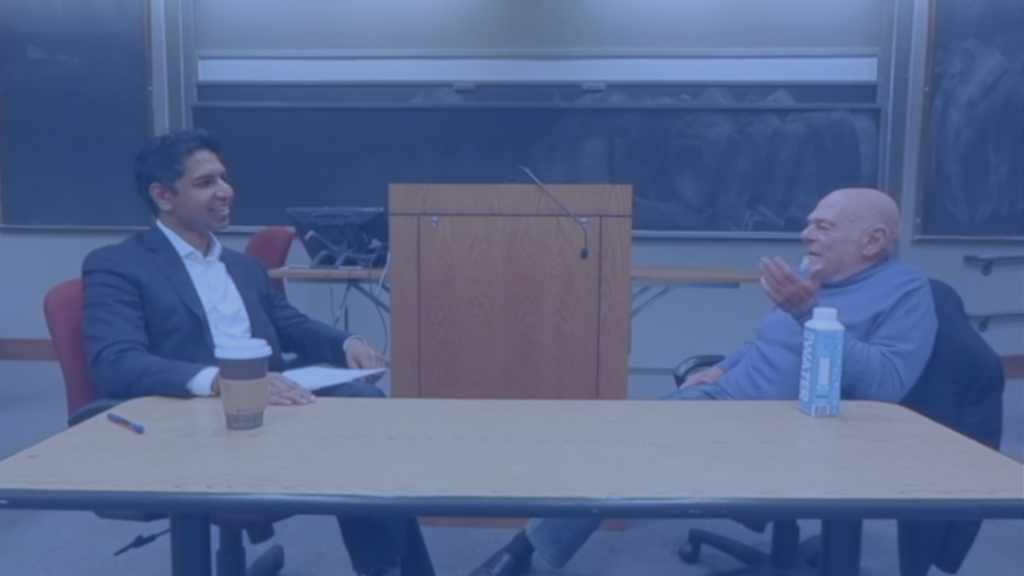
Arvind with Brad Jacobs
In addition to leading Worldly, Arvind is a professor who has received a university all-star teaching award and brings deep real-world insight into the classroom. Each year, the course features conversations and lectures with distinguished guests who share candid perspectives from senior levels of business leadership, offering students exposure to industry thinking and practical insights within an academic setting. Guest participation is strictly for educational purposes only.
The videos and individuals shown are for illustrative and informational purposes only. The appearance of any person does not constitute an endorsement, testimonial, or recommendation of Worldly Partners, nor does discussion of specific companies constitute investment advice. No individual shown is being compensated for their appearance, and their statements (if any) are not representative of the experience of any clients or investors. Nothing presented should be construed as individualized investment advice.
Brad Jacobs
Brad Jacobs: The Meditator-Musician Who Built 8 Multibillion-Dollar Companies
In this Distinguished Speaker interview, serial entrepreneur Brad Jacobs explains how his disciplined M&A strategies, daily meditations, and background as a musician have given him the clarity, calm, and intuition needed to build eight multibillion-dollar companies. Emphasizing the importance of mindfulness, acceptance, harmony, and rhythm, Jacobs’ advice for creating value extends beyond the balance sheet to every aspect of life.
Full transcript
Introduction
Arvind Navaratnam (00:00:11):
Brad, thank you so much for being here. I want to be super efficient with our hour today, I’ll keep my opening remarks brief. Brad is the chairman and CEO of QXO, a technology enabled leader in the large and fragmented building products distribution industry. Over more than four decades, he has founded and led eight companies, completed hundreds of acquisitions, and built major businesses, including United Rentals and XPO.
The students have been preparing all semester for our time together, Brad, and have read your books, listened to your interviews, and closely studied the companies you’ve built. I’ll be asking the questions the students prepared on their behalf for our smooth fireside session. Thanks again, Brad, and let’s get started.
Childhood and early influences
Brad, maybe we can start towards the beginning, could you talk a little bit about the factors from your early childhood that you believe most shaped the entrepreneur and leader you became?
Brad Jacobs (00:01:13):
Well, sadly, my early childhood was a long time ago, my memories are not crisp. I don’t know, I mean, I would say education. I had some fantastic mentors and teachers that really motivated me to think differently. I think on the other hand, I remember driving with my father home once when I was, I don’t know, nine years old, something like that. And we’re parked at a light. My father was a big guy and with a low voice, and he said, “Bradley, it’s good that you have a good personality because you’re never going to get anywhere with those ugly looks.” And I was nine years old, I didn’t have the concept of good and ugly, stuff like that. But it was an important moment in my life because it like, “Oh, interesting. So I guess I must not be good-looking, but at least I got a good personality.” So I went with that. And I think that formed a lot of my motivation and my approach to life was to not so much focus on the superficial, but focus in on the inner, on the spiritual part.
Arvind Navaratnam (00:02:25):
I remember you talking about that in a podcast interview and the mixed emotions of hearing that from your father at such an early age. How did your mother really shape you?
Brad Jacobs (00:02:40):
My mother was completely the opposite. My mother was a typical Jewish mother, she thought I was the Messiah and everything was … I could do no wrong. My mother passed away a long time ago, but she listened to all my earnings calls every three months for 25 years. And at the end of each call, she would call and say, “That was the best call ever.” And if an analyst had given us a hard time, she said, “And that guy was way out of line asking that question.” My mother was a big cheerleader, a big, big, big, big cheerleader. Her whole life was just her three children, and that was her whole life. And she gave me a lot of self-confidence.
Lessons from Ludwig Jesselson
Arvind Navaratnam (00:03:18):
That’s great. You’ve talked about Ludwig Jesselson as an important mentor in your life on numerous occasions. What did he teach you that you understood intellectually and conceptually at the time, but only truly understood after you had built businesses yourself?
Brad Jacobs (00:03:42):
I learned a lot from Mr. Jesselson, a real lot. And I’m very grateful for him having done that. I definitely would not be in the position I am today without his guidance and his mentorship when I was younger. Of the many, many things that I learned from him, probably the most important one was to look at problems as good things, as opportunities to make money.
I used to have lunch with him once a week in his office, and one day I came in and he looked at me, he said, “You look glum, what’s going on?” I said, “Well, I got this problem and I got this problem over there, and I got this third problem.” They’re all weighing on me. He said, “Look, if you’re going to be in the business world, you need to rearrange the way you look at stuff. Problems are good. If there are problems, those are opportunities to, if you solve them, create value to make money.” So he said, “If you don’t want problems, if you’re not comfortable with problem solving and with conflict and with all kinds of [foreign language], all kinds of … Yiddish word for aggravation,” he says, “Don’t go in the business world because the business world is all about that. Go be an artist, go be an academic professor, go be a musician, do anything, but don’t … be a lawyer, but don’t be a business person because business is all about problems, solving the problems, and then moving on, going to the next thing.”
And I did understand it at the time, but I’m still absorbing the profundity of that and the importance of that. And how to completely change my approach to radically accepting difficult things. And not just merely accepting them, but embracing them and rejoicing in them and feeling grateful for them. That, wow, I got a problem. If I can solve this problem, I’m going to create value. Wow, I got another problem, this is a big, ugly problem, and if I can solve this huge, big, ugly problem, I’m going to make huge, huge value for my shareholders. So that frame of mind was a very, very important thing to adopt. And I’m still learning about that, it’s still unfolding over the decades.
Arvind Navaratnam (00:05:59):
Yeah, no, there were a lot of student questions around that. And I’m excited to delve into that. It’s really special and really differentiated, I think, from other successful business people. Others share that point of view, and as you’ve said in other discussions, there are many ways up the mountain and successful people have different perspectives and philosophies, but I think that’s a really special insight, that enjoyment from problems.
Brad Jacobs (00:06:30):
It was. As with many of the things he taught me, they were seeds planted, and they developed over time and then they matured over time. And they were multifaceted, they’re multi-level wisdom, which is the best kind of wisdom.
And that one thing I just shared with you led to a lifelong quest for being aware of how I think and being very conscious of the thoughts I’m having. And to be disciplined at being objective with those thoughts. Well, first, being accepting of those thoughts, that these are natural things, don’t fight nature. Number two, evaluate which ones are rational, which ones are constructive, and which ones aren’t. And with the ones that aren’t, reframe them, come up with a new way to look at a situation. There’s many, many different ways to look at a situation. And if you can look at situations with a certain perspective, generally a wider perspective, a tolerant perspective, an accepting perspective, life is happier. It’s much, much happier. And also your thought process is more powerful and clear.
And I think that if you want to accomplish something big in life, whether it’s making zillions of dollars or whether it’s just accomplishing something in any field, you got to pay attention to your mind. That’s the first thing you got to pay attention to. You can’t accomplish big stuff if your mind is petty or your mind is irrational or your mind is full of anger and fear and anxiety, you need to work on that stuff. You got to figure out your own way to deal with that stuff so you’re in a good mind frame, you’re in a good emotional state. That’s something I’m still working on, but I’ve made a huge amount of progress.
Arvind Navaratnam (00:08:21):
Yes. There’s a lot there and a lot there that I want to talk about that the students have posed. And maybe we can come to it as we get to that area. I’m curious, is there anything that Mr. Jesselson believed that you eventually decided was wrong?
Brad Jacobs (00:08:48):
Well, Mr. Jesselson was always trying to get me to be an observant Jew. And I could never do it, I just couldn’t do it. I couldn’t take one day off a week, first of all. I work seven days a week. I love working. I love it, I’m just addicted to it. And to take Friday night off, Friday night to Saturday night off every week, I felt that was a very big loss of productivity. And not just the one-seventh of the week, but the continuum. So if you zero in on something and focus on it and just hold onto it, don’t let go, for long extended periods, it can turn into something really beautiful. It can turn into something very, very powerful.
So I didn’t buy into the whole concept in Judaism of work six days and then seven day take off. I never became Shabbat Schomer. That was not my thing. But I don’t know, maybe I would’ve been more happy and more successful and a better human being if I had observed Sabbath, but I never got into it.
Choosing QXO and building products distribution
Arvind Navaratnam (00:09:51):
That’s interesting. So turning to QXO, you said that you studied hundreds of companies across roughly 55 industries before choosing building products distribution. You described the sector as a safe bet because building products are not going into the metaverse and said it checked every box for you. What were those boxes?
Brad Jacobs (00:10:18):
Well, first of all, to corroborate that I’m not exaggerating, you can ask Kevin Kelly, who I saw in the call, but I worked with what was then called Sequoia Heritage, now it’s called Heritage Partners, in analyzing all those. So what were we looking for? What we’re looking for is things that matched my team’s skillset, which are creating value by consolidating an industry. I’m famously a one-trick pony, it’s a great trick, but I’m a one-trick pony. It works really well, but it’s very narrow, it’s very precise. It’s finding an industry that’s got some organic growth to it, that’s not consolidated yet, that’s fragmented, where you can buy things at lower valuations than what your currency is. So your cost of capital is lower than what you’re spending it on. And that you can improve businesses and bigger is better and scale’s your advantage. That’s not always the case in every industry. Economies of scale.
And I was trying to find an industry that was tech backward because I’m a big, big adopter of tech. And I wanted to find an industry that was in the stone ages on tech because we could bring fantastic tech and upgrade it. So building products checked every single one of those boxes. It was the first one that checked every single box. I had many, many things that I looked at that checked some of the boxes, but not all of the boxes. And I like this one. This one matches what I know how to do.
Arvind Navaratnam (00:11:52):
Interesting. Kevin, do you have anything you want to add on that? I don’t mean to put you on the spot, and I don’t have to, but Brad-
Kevin Kelly (00:12:00):
I think like Brad said, it was fascinating to watch how he chewed through all the different components of GDP before landing on this category. So it wasn’t like there’s three things that could work, let’s do some perfunctory work, and here’s one that floats. And so it was a very, very wide range.
And I think because of how big Brad thinks, there were things that we talked about that could definitely be ways to make a little money or to put a nice tiny business together. But from the start, the orientation was toward building a big, important, meaningful enterprise. And so market size and capacity to run the play for a long period of time was particularly important.
And then just working his network and the networks around the table to try to pressure test the hypothesis of it seems like the industry is backwards from a technology perspective, but going and having a hundred conversations to disprove his thesis. Versus trying to go out and find two people who agree with him and then finding an excuse to go.
Arvind Navaratnam (00:13:11):
Were there any, Brad and Kevin, as you were evaluating the opportunity, were there any key concerns you had entering? I mean, everything has hair on it, so before you started executing, was there any key concerns that came up?
Brad Jacobs (00:13:29):
Key concerns about building products?
Arvind Navaratnam (00:13:30):
About the opportunity in terms of the map versus the terrain. So when you’re thinking about it as a thesis, you think it checks these boxes, then you’re doing your diligence to destroy the thesis, and it’s looking good, but nothing’s 100% when you put that first dollar to work or first hundreds of millions, billions of dollars. So what were those key concerns that you wanted to minimize risk early on as you were thinking through the thesis? Does that make sense?
Brad Jacobs (00:14:05):
Well, I completely agree that there’s nothing that’s got no risk at all.
Arvind Navaratnam (00:14:11):
Of course.
Brad Jacobs (00:14:12):
I mean, nothing in the whole universe is without risk. Things can change and there are threats and there are disruptions and there’s things that have a time value when they’re valuable, and then after that, suddenly they’re not valuable anymore. There was no real deal killer, otherwise I wouldn’t have done what I did. I like building products and I still like it. I think it matches the things I know how to do, the things I want to do, the things that I know provenly makes money over time. So there really was nothing like a deal killer.
Arvind Navaratnam (00:14:43):
Right. There were mitigants that you were comfortable executing on to minimize those concerns?
Brad Jacobs (00:14:49):
Yeah.
Arvind Navaratnam (00:14:50):
Yeah, okay. That makes sense. Were there any surprises as you’ve actually executed versus your original thesis?
Brad Jacobs (00:14:58):
Oh yeah, all the time. So what surprises should I list? Maybe there was surprise that the mortgage rates went up. And look like they’re still going up. That building activity plummeted way down. It was a surprise that weather, which affects building quite a bit, was inhospitable to construction.
I don’t try to bottom tick. I don’t try to get in at the very, very bottom. I don’t think anybody’s smart enough to do that. I try to just participate in the whole cycle, and buy down here, buy here, hopefully, but not buy too much up here. And then just grow the business, grow the business.
But in terms of timing, short term, terrible timing, I mean, absolutely horrible, horrible timing. We bought three companies and the bottom fell out of the whole housing market. But I couldn’t care less. This is a small, small moment in time that sooner or later the cycle turns.
I like cyclical businesses. A lot of investors don’t like cyclical businesses. I love them. I love them because sooner or later the cycle’s going to turn and it’s going to get better. And I think where we are in the cycle now with housing is pretty troughy, if not at the trough, pretty close to the trough. So that was a surprise though, that was not the plan. I didn’t feel that a year ago that housing was going, and almost nobody did, housing was going to be on its butt like it is now. So that was the biggest surprise.
Acquisition pricing and valuation discipline
Arvind Navaratnam (00:16:39):
No, that makes sense. As you think about your deal making, how do you determine the maximum price that you’re willing to pay, a student asked, before competitive dynamics or enthusiasm for an asset begin to influence your decision?
Brad Jacobs (00:16:57):
Okay. You can’t see the room I’m in right now, but I have two antique chandeliers above me that are ridiculously expensive, and I acquired them at Sotheby’s 20 something years ago. And I sent my daughter there to go bid on them. And I said, “Get these for me.” And she paid three and a half times the estimate. And she came back, shew said, “Dad, I got them.” I said, “Oh, that’s great, what did you pay?” I said, “What? Couldn’t possibly have been that.” And she said, “Well, you said you wanted me to get them.” I said, “I didn’t say get them at any price. If there was some crazy rich person who was bidding three times the price, I didn’t say bid three and a half times the estimate.” So what did I learn from that? I have to put a discipline price, I can’t just say buy something.
So I apply that same concept to buying companies. I don’t change my opinion about what the right value is while I’m negotiating. I determine ahead of time what I think is an attractive price. What you pay for a company in the M&A game is very, very important. That’s the I on ROI. This is your investment. And if that’s too high, it’s harder to get a great R, a great return on the ROI. So you need to pay attention to the purchase price.
I remember I used to have a banker at Credit Suisse long time ago, he’s passed away, but he used to say, “Bid them up. You’re going to forget the price. A week after you buy it, you’re going to forget the price.” And I would always tell him, “Yeah, my balance sheet’s not going to forget the price though. It’s always going to be on my balance sheet. And the money I wired out of my bank account’s not coming back. It’s out, it’s gone. I wired it to the sellers.” So purchase price is very, very important. So you got to stay disciplined on the price.
It’s the cardinal error that M&A people make is they just overpay. And then they wonder a few years later after they overpaid for all these acquisitions, why hasn’t their stock price gone up? Why are they underperforming the market?
Look, if you’re a company, publicly traded company, even a private one, at the end of the whole thing, all you got is profit, depending on what industry is, that could be EBITDA, it could be EBIT, could be net income, whatever, but you got profit, and then you have a multiple on that profit, and then you have your debt, and that gives you your enterprise value. So the number of shares outstanding and the amount of debt you have is very, very, very important. So you want to be very frugal with issuing shares, whether it’s into the market to raise cash or giving it to sellers as part of the consideration, because you have that ball and chain around your ankle if you have too many shares out there. So you got to stay disciplined on price.
I’ve passed on so many deals over the years that were amazingly attractive deals with growth and with an angle and with some way we could have turbocharged the growth and it would’ve synergized so much with something else we already owned, but the price didn’t work. We didn’t do those deals. And thank God we didn’t do those deals, they would’ve destroyed value.
So you got to, ahead of time, before you get all emotional and the heat of it and the chase, you got to set that price. That’s the price is the most I’m willing to pay. And don’t change your mind. Do not change your mind.
Second thing I would say is when you do deals, it can’t just be about numbers. It can’t just be about it’s accretive and therefore it salves all sins. There’s got to be a reason you’re doing the deal. There’s got to be something strategically compelling to your business model. In other words, when the press release goes out that you bought this company, you want to picture what your customers are going to look like reading it. If they’re going to get a smile on their face, they’re going to call you and say, “Hey Brad, I saw you bought this company, that’s fantastic because now you can help solve this problem I got for me or you can fill this gap there.” If it’s something that your customer’s going to look at it and they’re going to frown or they’re going to get upset about it, there’s no price that really, well, I shouldn’t say there’s no price, but there’s a very, very low price that’d be worth buying that company for. So there’s got to be discipline all the way around.
Arvind Navaratnam (00:21:20):
And so as you’re going through a process, you’ve never justified stretching beyond your initial valuation?
Brad Jacobs (00:21:27):
No, never. And I hope I never do. Hope I don’t get lazy on that and undisciplined. Now, there’s a trick to this. The trick is, don’t be looking at just one deal at a time or two deals at a time. You’re looking at dozens of deals at a time. If you want to be in the M&A game, you need to be properly staffed up. This is not a frugal game. You need a fulsome approach to the whole thing. And if you’re looking at lots of deals at the same time and you don’t have the capacity to do all those deals, you only have a capacity to do a small percentage of them, you can afford to be more disciplined. You can afford to pass because you’re going to pass on most of those deals anyways. So looking at many things simultaneously helps with being able to be selective.
Underwriting returns and synergies
Arvind Navaratnam (00:22:14):
Absolutely. When you’re underwriting a deal, how much of the return needs to work on a standalone basis before you start layering on synergies and integration benefits which are so important to your [inaudible]
Brad Jacobs (00:22:29):
I never take into consideration synergies for what I want to pay for a company. Because synergies are a real thing, I mean, almost every deal you get, you get a few percent of synergies, it’s very meaningful. A few percent of revenues, not EBITDA. So it’s some meaningful improvements in EBITDA.
But man, you got to work for those synergies. Those synergies don’t fall from the sky on your head. They don’t come with the deal. You have a large team of people with a long list of to-dos. And there’s a lot of headaches and a lot of execution, a lot of late nights, a lot of weekends, a lot of turbulence, a lot of firing people, hiring people, writing this off, closing this, opening this. There’s just tons and tons of stuff to do. Procurement, talking to all the suppliers and getting the customers to buy. There’s just so many, so many things to do. You earn those synergies. The seller didn’t earn those synergies. If the seller was able and willing to do those synergies, they would’ve done them and then would’ve waited a few years and then sold it to me for twice the price. But they weren’t willing or they weren’t able to get those synergies, we were. Those are for us. We should not be paying the seller for what we’re bringing to the table, which is the synergies.
Now, we look at synergies internally to get comfortable that this is an exciting deal, that this is something that’s got, it’s not just a great cake, but it’s got a great sugary icing on the cake and it’s got a candle and it’s got a strawberry. But we don’t pay for the icing or the strawberry or the candle, we pay for that cake. We don’t pay for the synergies that we add to it.
Improving pricing, sales, costs, and talent
Arvind Navaratnam (00:24:06):
Right. Makes sense. Thinking of a business where you actually doubled profit, can you walk us through the bridge afterwards, across pricing, procurement, technology, organic growth, what mattered far more than you expected and what mattered less?
Brad Jacobs (00:24:28):
Well, it’s the same checklist of suspects to look at in any acquisition. In some acquisitions, some of the elements will be greater and some will be less, but it’s the same list. It starts with pricing. Pricing is always the best lever because pricing has no cost associated with it. So every penny you get on price goes boom right to pre-tax. So pricing is always number one. It’s the most beautiful lever in all of business.
And if you buy a company that is very sophisticated on pricing, most companies aren’t, but if you find one that’s sophisticated on pricing, that’s a bad thing because you can’t optimize it. Most companies don’t price in a scientific way, an algorithmic way, they price based on what the market will bear or what the customer tells them another competitor is charging them or they take the cost and they increase the price. That’s not the most efficient way to price. So pricing is number one.
Second one is procurement. So in different businesses, procurement is a bigger deal or not as big a deal, but all companies buy things. And companies that are really strong in their procurement muscle buy things a few percent cheaper, sometimes more than a few percent cheaper. So procurement’s a big, big lever.
Sales, sales force effectiveness, always a big lever. Are you set up and properly staffed with properly trained salespeople, with enabled salespeople, with the right technology, with the right compensation for those salespeople, with the right motivation for those salespeople, with the right controls and sales management for those people, with the right sales plan for those people so they can go out and conquer, they can go out and slay? That’s a big deal. So most companies that you buy, you’ll find average sales. They got some of the things I just mentioned, but not all of them. And even the ones they got, maybe they aren’t world-class, they’re okay in them. They’re pretty good, but not great. So sales is a big, big, big lever as well.
Then you have the cost structure. Companies often are not self-reflective enough. I can’t tell you the number of CEOs over the years that I’ve met and I said, “Walk me through your org chart.” And they don’t know their org chart. You got to know your org chart. That’s what you got. You got a bunch of people and the way they interact with each other. That’s what a company is. So you really need to know how many salespeople I got and where are they? Are they in locations because I just inherited them in a kluge kind of way because I did a bunch of acquisitions, so that’s where all the people were. And now you got three times as many people in the sexy places, like in the Sunbelt, and you don’t have enough people at all covering very lucrative markets, but aren’t really hot markets, but lucrative markets due to margins, maybe Minnesota, maybe Montana, maybe Wyoming, maybe North Dakota, a little off the road places. So do you have the right salespeople in the right locations?
Are you targeting the right customers? Do you have a clear understanding of where you’re making your money? What’s your margin and what’s your growth of all your different categories of customers? And where can that be optimized? Where can you spend less resources chasing low margin, low growth customers, but put more energy and more resources into chasing high growth, high margin customers that have better returns?
Then there’s the people element. The most important thing, and I probably should have said this first not last, the most important element are the people. And I like to use the organization itself to evaluate its own people. I don’t like to come down like I know everything and I’m going to come and I’m going to interview someone and I’m going to … What I like to do is 360s. Meaning every individual gets a review from their boss, from their peers, and if they have direct reports, their direct reports.
And the most important question that I like to ask in those 360s are, what would you feel like if this person came into your office today and said, “I quit, I’m leaving. In fact, I’m leaving tomorrow. I’m moving. I’ve already bought a house.” And I give them three choices of what the answer could be. The first answer is, “I would feel traumatized, I would be in a state of panic because this person is so darn good, I’m never going to be able to replace her or him with someone as good as them. They don’t exist. And how the hell did I let myself get in this situation where I’m losing this A player?” That’s A.
The B response is, “Not great, but I’ll deal with it. I’ll hire a headhunter. I would prefer them to stay because they’re okay. And they’re not amazing, but they’re okay, they’re good enough. And it’s one more hassle, but okay, life’s full of hassles. I’ll hire a headhunter, maybe I’ll get someone even better, who knows?” That’s a B.
If the answer is a C, C means I feel relieved. I feel the company will actually be better off without this person here. Could be for many, many different types of reasons. Could be they’re not competent. Could be they’re competent, but they’re a jerk, they’re not collaborative, they’re not collegial, they don’t get along, they’re toxic. It could be they’re dishonest. It could be they’re out for me, me, me and not us, us, us, not we, we, we. So a lot of different reasons. But for whatever reason, if the majority of that person’s ecosystem, the people they work with all day long say, “We’d be better off with this person gone,” you got to get rid of those people. Almost with no further review. Sometimes there’s extenuating circumstances, but if you have 11 people review you and nine out of 11 rated you a C, the chances are nearly 100% that we’ll be better off without that person.
Now, in all the companies I’ve bought, hundreds of them, I’ve found shockingly that the percent of C players, who get rated C on that, is roughly about 20%. A typical company, one out of five employees, their peers, their boss, their direct reports would like them to leave. So I help fulfill their dream. I exit those people as soon as I possibly can. Because you can accomplish so much more with a team of A and B players than you can with a team of A, Bs, and a typical component of Cs. You don’t want the Cs, you just don’t want the C players.
Arvind Navaratnam (00:31:30):
Sure. And so there was a lot there, it was fantastic. But when you contrast it to your earlier comment about price versus synergies, you’re not paying for any of this, the pricing improvements, the supplier improvements, et cetera?
Brad Jacobs (00:31:52):
No. There’s an exception to every rule, but generally speaking, for the large most part, we want to pay on what the company’s earning in the last 12 months. Sometimes you get slightly undisciplined, you’re paying for what they’re going to earn for the next 12 months. But you better have a lot of confidence that that estimate for the next 12 months is going to happen. Because companies miss their estimates, particularly when they’re for sale. They have these lofty hockey stick estimates, what they’re going to do next year. “We’re going to da, da, da. Profits are going to go up huge amounts.” And it usually doesn’t happen. Often it happens the opposite. So trailing 12 months is real, it’s history. It’s easy to look back and see what happened. So I like to pay on trailing 12. And I like to pay at a deep discount to what my cost of capital is.
Centralized and decentralized acquisition models
Arvind Navaratnam (00:32:45):
I’m not sure, are you familiar with a company called Lifco, the industrial serial acquirer in Sweden by any chance?
Brad Jacobs (00:32:51):
L-I-F-C-O?
Arvind Navaratnam (00:32:53):
Yeah.
Brad Jacobs (00:32:54):
No, it’s a nice name though, but I don’t know it.
Arvind Navaratnam (00:32:56):
No, you may find it interesting and want to check out. But they’ve been very successful over decades. They’re an industrial serial acquirer, they buy niches. And the reason I mention it is we spent a couple of hours last week talking about it as a class as a case study of this model and its success because there’s this multi-decade track record amongst them and Indutrade and other players in the space. And they are a cyclical serial acquirer and one of their big tenets is not buying off an LTM, but buying over a cyclical, using a cyclical EBITDA multiple. How do you think about that? So they take a longer history.
Brad Jacobs (00:33:47):
There’s some wisdom to that because the trailing 12 months could be either unfairly inflated or deflated because it’s just 12 months. So looking at a longer period of time makes sense, I can understand that. And yeah, I don’t dispute that’s an interesting way of doing it.
Arvind Navaratnam (00:34:05):
Okay. Yeah, no, I just thought it was an interesting observation you made, and interesting always to contrast two successful models. They don’t centralize, they’re part of a decentralized monster set, think of Constellation Software, but focused on the industrial space.
Brad Jacobs (00:34:28):
That’s not my way of doing it.
Arvind Navaratnam (00:34:32):
Yeah, absolutely.
Brad Jacobs (00:34:32):
My way is not the only way, but it’s my way that works for me. I like to have one company.
Arvind Navaratnam (00:34:38):
Absolutely.
Brad Jacobs (00:34:38):
One culture. As close to one brand as possible. I like to have one procedures and policies, guidelines. Like to have one way of doing things. I like to have consistency. Like to have standardization as much as we can so that we have a machine that works and functions and can scale and scale. We can wash, rinse, repeat, wash, rinse, repeat, wash, rinse, repeat. And if you have all these different companies and they’re not really one company, it’s hard to do that. It’s hard to build a brand. It’s hard to get the esprit de corps. In a company, morale is really important, really important. And that’s why we measure it. We measure it with surveys all the time.
And if you’re one company … We put out an email every single morning, it’s called QXO AM, to everyone in the company who has an email access. It’s just two pages. That brings them up to date on stuff we’re doing around the company, celebrate wins, share problems, give customer views. And people love it. People love it because they feel they’re part of a large organization. They don’t feel like they’re just this little branch with 30 people in it. They feel they’re part of something with 28,000 people. And other people’s success is their success, their pride, it’s a collective win. I think it’s hard to do that if you just buy a bunch of companies and let them be.
I have a lot of admiration for these private equity firms that do exactly the opposite of what I do. These private equity firms buy these smaller companies that are like 10, 20 million EBITDA companies, and they pay small multiples because they’re small. They pay five times EBITDA, six times EBITDA. They build them up. And suddenly they’ve got a couple of hundred million dollars EBITDA. They go, “Wow, I got a couple of hundred million dollars EBITDA. Bingo, I must be worth 12 times EBITDA.” So they put some leverage on it. And they’ve got multiple expansion. Even if they don’t do what I always try to do, which is to dramatically improve the profits of the business, they still make value because they get multiple expansion and they bought real cheaply.
But the artist in me doesn’t like that. It’s against my nature to put just a financial engineering conglomerate together. I like to build a real enduring lasting company, one that long after I built it it still exists. And long after I’ve left, it still exists.
Arvind Navaratnam (00:37:10):
No, it’s definitely a beautiful canvas that you painted. And I think the learning here that I’m trying to draw out is that there are many ways up the mountain. And just there’s a real beauty to contrasting the-
Brad Jacobs (00:37:21):
And I completely agree with you. In almost everything in life, there’s no one way.
Arvind Navaratnam (00:37:27):
Absolutely.
Brad Jacobs (00:37:29):
That’s the main problem we got in the world right now with this terrorism stuff is people have these beliefs that they’re right and if anyone disagrees with them, they got to kill them. It’s the nuttiest thing, it’s very irrational.
Scaling QXO while preserving its culture
Arvind Navaratnam (00:37:41):
Absolutely. So as QXO pursues its $50 billion revenue goal, and eventually runs into the law of large numbers, what has to change in the playbook as a company becomes very, very large? And what absolutely must not change to you?
Brad Jacobs (00:38:07):
Well, that’s absolutely right, the law of large numbers is a real law. It’s so much easier to grow from nothing to a few billion dollars, than to get a few billion dollars to tens of billions of dollars. And it’s even harder to go from tens of billions to hundreds of billions. And I’ve never done it, but I’m sure it’s a lot harder to go from hundreds of billions to trillions. So the law of large numbers is a real problem. It’s a real, real thing.
Now what has to change, what has to not change? What has to not change are the core principles and core values of the company, the culture, the way people interact with each other. And the ideal way to interact, in my experience building a company that’s fast moving, is encourage people to disagree with each other but in a nice way. Be dialectical, be looking at things from different perspectives. If your day went by and you didn’t have three or four debates with your colleagues about choices we’ve got, about decisions we could make, that was not a productive day. That was not a good day.
A good day is one where you had some passionate discussions, passionate discussions about we need to go right and here’s the reasons why. No, we need to go left, here’s what you’re missing because X, Y, Z, left is a lot better than right. Third person comes in, you’re both right and you’re both wrong, we need to go center and take two of your things and two of your things and bingo, that’s a solution. This is a beautiful conversation. This is a conversation that makes money. That’s a conversation that solves problems. Going back to the beginning of our conversation. That’s how you solve problems, you look at it from all these different angles with all these different biases and all these different prejudices and all these different prisms that reflect our histories, and you come up with something really powerful, come up with something really true, something really deep.
So you want in the culture, this nonstop, I was going to say bickering, but it’s not bickering, it’s presenting different opinions. My niece, when she was in high school, she was big in debating, there was a debate club, and I always respected the way she did it. They would have a proposition and you would argue against the other person, then you would switch sides and each one would have to argue the opposite. This is brilliant, this is really, really good. You can, not attack the people, attack the ideas, attack the thoughts, but be very respectful to the people. People who have different opinions of you are friends. That’s a good thing. It’s an ally to have someone who looks at things differently, then you have diversity of opinion on that stuff. So that you got to keep. The culture has to stay the same.
What has to change is, as you get bigger, what people … So in the branches in any business, that doesn’t change very much, that’s the unit, that’s the branch unit, that’s the store. It doesn’t change very much. But above there, it changes a real lot, in the districts, in the regions, in the divisions, in corporate. It’s a whole different deal. Because as you get bigger, you must delegate things that previous … So you’re growing and at each quantum of growth, you have to, at all levels above the branch, get used to letting go more and not micromanaging as much because you won’t get anything done. Nothing will happen. Nothing will reach a conclusion if you’re micromanaging all this stuff. So you got to let go. You got to let go and you got to make sure you’ve got the right people beneath you who have good sense, very rational people who can think clearly because you have to trust them. If you don’t have trustworthy people there, it’s not going to work. So you get honest, trustworthy people who are competent and let them run, let them run within parameters.
Now, as you get bigger, you have to put in more process, you have to put in more controls, you have to put in more governance, but you can’t overdo that. If you overdo that, then you get what I call big company-itis. It’s a disease. You get all this red tape, all this bureaucracy, all this slowness, all this paralysis from analysis stuff. So you got to be lean, you got to be lean even as you get big.
Public markets and aligned long-term shareholders
Arvind Navaratnam (00:42:27):
That’s great. In the class we’ve spent a lot of time discussing the importance of alignment between employees and the company, management and shareholders and strategy and capital. You chose to build QXO through a public company and raise substantial equity before the acquisition pipeline was fully visible. Why was a public vehicle the right structure for a long duration consolidation strategy?
Brad Jacobs (00:42:57):
Well, we’ve raised about $30 billion of debt and equity. Actually a little more than that because we refinanced some debt, so 30 something billion dollars, in a very short period of time, in 18 months. That has changed and the private markets have ballooned, and that probably would be possible now. A couple of years ago that would not have been possible. The private markets were not as developed. And you could raise money, but you couldn’t raise tens of billions of dollars privately. I mean, now you can. I mean, now these hyperscalers and these AI guys raise hundreds of billions of dollars, it’s really changed quite a bit. But it wasn’t there.
My businesses are always capital intensive. My businesses always are … I deploy a lot of capital. And the allocation of capital is a key part of why we win, because we allocate capital with thoughtfulness and care. But I remember Kevin’s senior advisor, Michael Moritz, when he was running Sequoia years ago, used to tell me that his business was the business of investing as little money as possible for enormous returns. And so you got to be careful about that.
Arvind Navaratnam (00:44:10):
But how do you think about the alignment of public market shareholders who often operate with very short time horizons with a strategy that would require the significant upfront capital, patience and periods of uncertainty around acquisitions, et cetera, how do you think about that alignment?
Brad Jacobs (00:44:29):
My biggest financial supporter, apart from myself, my biggest outside financial supporter has been a guy called Adam Karr, who was the president of Orbis Investments, O-R-B-I-S, out in San Francisco and Bermuda. And they’re contrarians, and they’re long-term contrarians, and they’ve done extraordinary well. The returns have been fantastic because they stick with discipline to that philosophy of buying out of favor stocks at cheap prices and then waiting out the cycle, waiting it out, and then selling when it’s high. Buy low and sell high, how about that for an innovative idea?
In my company, if you look at my share register, most of my shareholders are the same old shareholders I’ve had at XPO and TXO and RXO, United Waste, United Rental, it’s the same crowd. So they’re not, by and large, looking for a quick hit. They’re not looking for something that they’re going to get in and out of it and make 40% or something like that and be happy. They’re looking for big kills. They’re looking for big returns, huge, huge MOACs, and that takes time. I don’t know how to get huge, huge returns in short periods of time. I do know how to get huge returns over a number of years.
So the types of investors that we’ve attracted, that are supportive of this are ones who are aligned with our strategy of let’s go for the big kill. Let’s try to hit something out of the park. And let’s do what we have to do, let’s make all our decisions on allocating capital and businesses, of what we buy and what we do and who we hire and how much we invest in technology, et cetera, let’s base all those decisions on what will this affect our customer value prop five years from now, 10 years from now? What will this do for shareholder returns over a decade? Everything. Everything’s always in that context.
If there’s a trade-off where we have a decision, that’d be fantastic for the quarter, for the year, but it’s not really great long-term, we don’t do that. We just don’t do that. Conversely, if there’s something that is a hit on earnings now and going to be a drag for a year or two, but man, there’s a tremendous ROIC on this over time, we’ll do that 10 times out of 10.
My particular shareholders get that. We’re aligned with that’s what we’re trying to do here. So I don’t get pushback from my shareholders to say, “Can you think more short term, Brad? Can you just worry about the quarter more?” We don’t even do quarterly earnings calls. We’re a public company. We have 25 plus billion dollar enterprise value. We don’t do earnings calls every quarter. I don’t believe in them. I think they’re a waste of time. It’s sell side analysts peacocking for hedge funds. It’s like there’s no value created from those calls, so we just don’t do them. We don’t prepare for them. We don’t hold them. We just talk to shareholders directly.
But the subset of shareholders, a lot of shareholders, there’s tons of investors, there’s no shortage of investors in the world, we select our shareholders. We select the ones that, and they select us, who have an affinity of interest, how we look at things long term.
Arvind Navaratnam (00:47:39):
Yeah, no, it’s really special to be able to build that over time. And certainly Berkshire and other institutions have accomplished that over long periods of time.
Brad Jacobs (00:47:48):
Well, they’ve accomplished it better than I have, Berkshire Hathaway.
Meditation, perspective, and resilience
Arvind Navaratnam (00:47:51):
Well, you’ve got some time. So turning towards the end, you’ve described a meditation where you expand and contract your perspective almost like an accordion moving through enormous scales of space and time, which I found fascinating. Has a specific business insight or major decision ever emerged from that, and can you give specific examples?
Brad Jacobs (00:48:23):
It’s deeper than that, it’s my whole life, my whole life is … I don’t consider myself a businessman, I really don’t, even though that’s what Wikipedia calls me, but I didn’t write that. I consider myself a musician.
So when I was a kid, I studied music and math. And I had a music professor at Bennington College called Bill Dixon who had a tremendous influence on me, a huge, huge influence on me in many different ways, not just on music, but the principles he had of utilization, of improvisation, of teamwork. These are deep core principles of how I’ve led my life and how I’ve structured my businesses too. And I don’t know, seven or eight years after I left Bennington, and I was in New York and I made some money, had a fancy apartment in Olympic Towers, high up, and he was playing a gig in New York. And he crashed at my apartment. And we’re overlooking the window, we’re looking down on New York City, and I was real proud. I said, “Wow, I made it. He’s going to be real proud of me.”
And Bill looks over to me and says, “Brad, you really fucked up.” “I really fucked up. What did I do?” He said, “You could have been an impactful musician, you had talent, you could have worked your chops, you could have made a difference. You could have really made a significant contribution to the world of music. And you could have touched lives, you could have stirred people’s souls. Instead, you’re chasing this money stuff. What for? It’s such a waste of time. It’s beneath your level.” That was a big jolt for me, what he said on that.
So my approach towards life, my approach towards business reflects a lot of what you said before about being in touch with time and space. Huge, huge time, huge, huge space, tiny, tiny, tiny, little tiny, tiny little space, way up, way down, way inside, way outside.
I do a qigong exercise pretty much every morning where I close my eyes and I go like this and I say, “I am in the universe.” And then I open my arms and I picture the whole universe, huge, huge trillions of miles. And then I bring my arms in and I go like this and I say, “And the universe is in me.” And I picture the universe all in my hands. Sometimes I bring it up and I swallow it, I eat it and I become the whole universe. And I expand that. Now more recently, I’ve been doing it multiverse instead of universe. For 20 years, I was doing universe, and then I switched it to multiverse. I don’t know, I just said, “Let’s do multiverse instead.” Multiverse, of course, is an infinite number of universes.
So in the morning, I wake up and I go, “I am the multiverse,” and I get this big smile on my face like, “Whoa.” Infinite in every single possible … as big as you can possibly get. And then I go, “And the multiverse is in me.” And then I even swallow the multiverse. So I love doing these things. I love doing these meditations. And that’s my life. I’m listening to sounds all the time. I’m listening to rhythm. I’m listening to timbre.
I was interviewing someone just a couple of hours ago. And I’m having a normal conversation with him, but I’m also abnormally listening to him without the understanding … with trying to not take in account the meaning of his words. I’m listening to the sound of his voice. I’m observing his breathing. I’m looking at his body. I’m looking at how he’s reacting to the environment. And I’m getting a vibe from that. I’m getting a feeling from that. That’s my whole life, is just doing all these weird things with my perception.
I have a thing called tinnitus, where since I was a teenager I listened to too much loud music, I had this ringing in my ear. Now, some people go to therapy to deal with that, and they go to the Mayo Clinic to cure themselves, weird things, stuff like that. I love it. I love it. Right now, I’m hearing it. I love hearing that. I feel special. I feel blessed. I feel I have the sounds of the universe ringing in my ears.
My answer, I’m trying to give to your question is it’s broader. My approach to living is to try to embrace it so deeply and to really feel grateful that I actually can breathe, because I’m not going to be able to breathe forever. At some point in time, we don’t breathe anymore and we die. To feel very grateful and very appreciative that my heart works and it pumps and all these fun rhythms and it puts blood everywhere. That’s not going to be forever. I really appreciate it while I got it.
Another music professor I had in Bennington was a guy called Milford Graves, fantastic musician. He did a thing where he put a stethoscope on his heart and then put it into a microphone and recorded it all, and he would play drums, because he was mainly a percussionist, he’d play drums. On the recording, you don’t hear the drums, all you hear is his heartbeat. So you hear his heartbeat reacting to the different rhythms. This is what, for me, life is. For me, life is getting in tune with the rhythms and then feeling and seeing patterns in that, trends in that, things you can capitalize on.
And that’s how you make money. You make money by seeing time, looking forward, you make money by looking backwards in time and seeing how did we get to where we are right now. And really understanding that with great specificity. And then saying, okay, here’s where we are, where’s this thing going very clearly. And then figuring out a way to capitalize on that trend. You got to be spotting trends. You got to be spotting what’s happened and where’s it going? That’s how you make money. You identify trends that you have high conviction in, and then you bet the ranch on it. Maybe not the whole ranch, but you bet most of the ranch on it. That’s how you make a lot of money.
Arvind Navaratnam (00:54:36):
That was really beautiful. If we can tie that a little bit to crucible moments and how that’s helped you. Because I just think it’s very interesting and your temperament’s very interesting. Because you’ve been doing meditation for a long time, and it’s really shaped the arc of your life. And you’re talking to students, this could transform their existence. A lot of them are business students. And so maybe it would be helpful for them if you tied it to … And you don’t have to, and if it’s not relevant, I’m not trying to force anything here, just to be clear. But if it’s … Yeah, please.
Brad Jacobs (00:55:18):
Let me address it like this. I wouldn’t say meditation is the magic bullet. Meditation is a bullet in a machine gun. And it’s different bullets in different people’s machine guns. You have to find what works for you to get your head in a good place reasonably all the time. I don’t know if it’s realistic to say you’re going to be in a great mood 100% of the time. I don’t know anybody actually who has achieved that. But I know people who have achieved 90%, 95%, 97%. They’re comfortable with themselves, they’re comfortable with the world, they’re comfortable with their place in the world, they’re comfortable with their limitations, with their defects. They accept themselves, they accept other people, they accept the universe just as it is with all its crazy imperfections, but they’re at peace with it.
And for me, I’ve had a lot of tools in the toolkit. Meditation, as you said, I’ve been doing it since 16 years old, so a long time ago, for a long, long time. But it’s only one of the tools. For me, an equally important tool is cognitive therapy. I did cognitive therapy for two years for three hours a week. And it was a whole new thing for me. I didn’t have any exposure to it at all. I didn’t know anything about it. And I learned from that that you have automatic thoughts and you don’t really even pay attention to them, they’re subconscious. And if you can tune into those and figure out and actually listen to your thoughts, hear your thoughts, it’s like music.
Tune into the music of your own thoughts, the symphony that your brain is creating all the time. And then sift through that and make some sense, take control of that. Rather than just due to our evolutionary influences having all these cognitive distortions. See the stream of thoughts that you’re having all day long. Feel the effect they’re having on your physiology and on your emotions, your behavior, on your clarity of thought, and fine-tune it. Influence it in a way so you become more rational, you become more objective, you become more intelligently thinking and behaving, you’re going to accomplish big stuff.
Now, that’s different for different people. For me, the combination of meditation and many forms of mind enhancement and hypnosis and qigong and a lot of different … mindfulness. And combining that with all the therapies that I’ve dabbled in, cognitive therapy being the most important one, but I’ve played around with dialectical behavior therapy, with positive psychology, with acceptance and commitment therapy, Ericksonian hypnotherapy. These things have worked for me. But that’s not the toolkit for everybody. For other people, it could be religion, could be the arts, could be quiet contemplation, it could be studying, it could be running, I don’t know. There’s almost an infinite number of variations of them.
Arvind Navaratnam (00:58:19):
Right. But I think, thank you for sharing that, I think it’s really important because it helps keep you centered as you-
Brad Jacobs (00:58:27):
Centered.
Arvind Navaratnam (00:58:28):
Yeah.
Brad Jacobs (00:58:28):
Centered, very good word. When I was in high school, there was a book that came out, I think it was called On Centering, and the cover of the book was two hands around a bunch of clay that was being made into a pot, into a vase. And the book was about centering, calming down, centering your mind and finding your …
And by the way, centering, I mentioned Bill Dixon before, my music professor, he talked about centering all the time, all the time. If you google Bill Dixon centering or back to the center, he used to call it come back to the center, come back to the center.
So the way he did his improvisational jazz was there was a tiny bit of structure, not very much, but just enough so it was coherent. And a key element of that structure was the center. Like this is what we’ll come back to. You all have your freedom, you, the percussionist, can do this, you, the violinist can do this, you the bass guitar guy can do this. But at a certain point, we have to stop being dissonant and have to be continent, we have to be in harmony and we have to come back to center. So he had a central point to his compositions.
The inspiration wall and building a team
Arvind Navaratnam (00:59:46):
I asked our mutual friend, Kevin Kelly, who’s at Heritage, what I should ask you. And Kevin said I should definitely ask about your inspiration wall. Can you talk a little bit about that?
Brad Jacobs (01:00:05):
I tore it down because I did a reconstruction, but I’ll tell you what my inspiration wall used to look like. I’m always changing. I loved it. I had it up there for 20 years. I got rid of it. So I used to have eight by 12 photographs of about, I don’t know, 50 people up on the wall who motivated me, who inspired me, who made me feel good. When I looked at their faces, I got a smile. I felt like I was a better human being for looking at their face. I used to have them up there all the time and I would look at them and spend time on them. And it was very motivating. I didn’t even know Kevin knew about that. I must have told him.
Arvind Navaratnam (01:00:45):
Yeah. Kevin, I don’t know if you’re still on or able to-
Kevin Kelly (01:00:49):
I am, yeah.
Arvind Navaratnam (01:00:51):
Yeah. Is there anything you want to push on this a little or anything else you think we should ask? I don’t want to put you on the spot either.
Kevin Kelly (01:01:04):
No, I think you’ve covered a lot of ground. Brad, the one other thing that I think is very interesting that you haven’t necessarily touched on is just how you build the team immediately around you and how that changes and evolves at different stages and scales of your consolidation. You mentioned the org chart, but you’re so intentional about both what those roles are and the right attributes at different forms of scale. Maybe a double click there would be interesting for the students just to understand how you think about XPO where it is today versus QXO before our first deal. And how you think about the right who in those instances.
Brad Jacobs (01:01:44):
It’s the most important question of the evening. Because the people that you immediately surround yourself with become the determinant of how successful or not successful you’re going to be.
Arvind Navaratnam (01:01:56):
Absolutely.
Brad Jacobs (01:01:56):
And the people that you have around you have to have a number of qualities. Number one, they got to be real smart. If you surround yourself with people who are not as smart as you, you’re actually not that smart because that’s not a smart thing to do. If you want to do the smart thing, hire people who are smarter than you. And pretty much all my direct reports are smarter than me. Some of them are much smarter than me, like 30 IQ points smarter than me. So smart is very, very important.
You need to surround yourself with people who want to work really, really hard. You want to surround yourself with people who have bags under their eyes because they only got four hours sleep last night. But you want to have people who are self-starters. You want people that the dynamic is you’re always telling them, “Will you please take at least a half a day off? Will you please introduce yourself to your husband or your wife? Will you please take your kids out to something? You’re working too hard.” You want people who are so excited, so inebriated with the mission, so bought into what you’re trying to do together, what you’re trying to create, trying to manifest that they get obsessed with it. They’re addicted to it. It’s like, “This is what I want to do, focus, focus, focus. I don’t want to do anything else. Everything else looks trivial and unimportant and a waste of time, but the mission is so amazing that we’re all going to do this together and we’re going to win, win, win.” You want people who are competitive and just won’t give up, won’t give up no matter what.
When you’re doing a startup or even when you’re doing after the company is much bigger and you still want to keep growing it, you need people who are all in, completely all in.
You need people who are honest, totally honest. I don’t mean people who are simpletons who are going to be bad negotiators, that kind of stuff. But I mean people who have integrity in terms of what they say, you don’t have to spend any time figuring out, well, what do they really mean? You want to be able to surround yourself with people who you can take at face value exactly what they say. What they say, you can literally accept it that that’s the right thing. That’s what they mean, that’s what they say, they’re not playing games here. You can take it to the bank what they just said.
You need to have people who on the one hand have these enormous egos because they’re trying to accomplish grandiose things and trying to set the world on fire and trillions and billions and all this kind of stuff. But paradoxically at the same time have a Buddhist no ego, have no ego at all. And are not about me, they’re about us. It’s all about the team. I repeat pretty much every day, often more than one times a day, the slogan, teamwork makes the dream work. And I believe in that real, real strongly. That you have to have a team of people. You can’t accomplish much by yourself. There’s just not enough minutes in the day. You need a group of people, and you need a group of people who complement each other. You need people who are good at this but not good at that. But that person’s good at that even though they’re not good at this. So that between the group of you, you got all your bases covered.
And the chemistry has to be right. If you have backstabbing or gossiping or lack of trust, you can’t do it. You just can’t get it done. On the contrary, if you have a group that is well oiled, wow, you can move mountains.
Advice on careers, technology, and living in the present
Arvind Navaratnam (01:05:21):
Maybe a final question, if I may, Brad, which is, in this room are undergraduates, MBAs, what advice would you leave them with as they think through their journeys both personally and professionally over decades?
Brad Jacobs (01:05:39):
Well, first of all, I’m honored to spend this time with you all. And I have respect for you all, what you’re doing at the school. I think you’re in a tough time. I think you’re in a very, very tough time because the world is going to change dramatically in the next decade, two decades. It’s going to be just a different … Whole life is going to be different. Humanity is going to be different.
Every institution that we’ve taken for granted is going to be disrupted, probably all of them, probably everything, government, education, business, everything, culturally, everything’s going to be … this whole AI, robotics, technology. It’s an inflection point in the history of mankind. That’s probably the biggest amount of change that’s ever happened in the past. And it’s unpredictable which way it’s going to go. Anybody who tells you I got a real clear vision of what’s going to happen in the next 20 years is wrong. That’s not correct. There’s a lot of question marks still. Is the AI itself going to hurt us? Maybe. I don’t know. Is the AI going to get in the hands of bad guys and they’re going to use it for malign purposes? Maybe.
On the other hand, the vision I would leave you with is, if humanity deals with this moment in an enlightened way, we could really usher in a level of abundance and wealth and happiness and health and longevity and knowledge and accomplishments and achievements that are remarkably unprecedented. And far, far, far, far greater wonderful things than has ever been achieved by humanity. And this is a big, big issue. And how we, humans, deal with this AI deal, and not just AI, but also the automation, the robotics, is going to determine which way this thing goes.
But it’s really uncertain. There’s a huge range of outcome here. There’s an outcome of obliteration and there’s an outcome of heavenly life on Earth. I mean, it’s just a crazy wide range of where this could end up being.
This has two ramifications. Number one, you got to plan your life. And you got to plan your life around that. And secondly, in terms of figuring out how to make a living in life, probably whatever you prepare yourself for, whatever skills you use to prepare yourself now won’t be the right things for what the world’s going to be like in 10 years or 20 years. So you all who are lucky enough to be younger than me are living in a time that is very unusual, very unusual. And it could end up really, really well. And part of what’ll determine whether it ends up really well is how we all deal with it.
Arvind Navaratnam (01:08:57):
How would you position yourself if you were 28 or 22 into this, I mean, you have children, as they think through the decades, how would you position yourself?
Brad Jacobs (01:09:09):
I would position myself trying not to think too much about the future because you can drive yourself crazy with scenario planning in this situation. And I would wholeheartedly embrace the present moment today. I would not be putting off till tomorrow to enjoy life and today suffering and struggling and compromising. I would focus on being happy right now, right now, like today, this week, this month, this year. And really giving some serious thought about what makes you happy? Where do you find meaning in life? Where do you find purpose? What really do you enjoy? What’s important to you? What are your values? What do you stand for? What do you want to be? What do you consider something that’s virtuous? And then pursue that.
Because the world’s going to change so much, I think it’s a fool’s errand to try to do long-term planning. It’s going to be very tough to do it. Now you can figure out things for five years, I think there’s lots of things to do, but if you’re young, if you’re in your 20s and trying to plan the next decades and decades like historically you’re able to do, I don’t think you’re able to do it. I think the world’s going to change in unimaginable ways. And we really can’t prepare too much for it. I think instead we should focus on enjoying now.
Arvind Navaratnam (01:10:37):
The beauty of that, Brad, is it comes back to the breath and your meditation and the power of now. And so on that wonderful note, you’ve been so generous with your time, thank you so much, and I’m going to go hug my kids and be in the now.
Brad Jacobs (01:10:54):
Thank you.
Arvind Navaratnam (01:10:55):
What a wonderful note to end on.
Brad Jacobs (01:10:56):
Appreciate it. Thank you so much.
Arvind Navaratnam (01:10:57):
Thank you so much.
Brad Jacobs (01:10:59):
My pleasure. All the best. Good luck everyone.
Arvind Navaratnam (01:11:01):
All right. Talk soon.
You may also like...



Our Address
117 Kendrick Street, Suite 300
Needham, MA 02494
Send us an email
info@worldlypartners.com
All rights reserved.